
InsightNew to LLD? Start with the Low Level Design roadmap, then use this guide to build your Java foundations.
Object-Oriented Programming (OOP) becomes much easier when we stop treating it as a list of definitions and start seeing it as a way to model a real system.
Imagine that we are designing a banking application. The system must represent accounts, remember each account’s data, and support actions such as depositing money or displaying account details. OOP helps us place that data and behavior inside meaningful software objects. 🏦
This article builds that foundation step by step. We will learn:
- what OOP means in Low-Level Design (LLD),
- how classes and objects work together,
- how constructors create valid objects,
- how object references and copying behave,
- how private constructors control object creation, and
- how the
thiskeyword identifies the current object.
The focus is not memorizing syntax. The goal is to understand the decisions well enough to explain and apply them in an LLD interview.
🎯 Why This Matters in LLD Interviews
An LLD interview is about turning requirements into objects with clear responsibilities and relationships. Before discussing SOLID principles or design patterns, you must be comfortable with the building blocks used to express the design.
For example, if an interviewer asks you to design a banking system, they expect you to reason about questions such as:
- What should a
BankAccountobject know? - What operations should it perform?
- How should an account be initialized?
- How do we prevent an invalid account from being created?
- When do two variables refer to the same account object?
- Should object creation be public or controlled?
These questions are really testing your understanding of classes, objects, constructors, references, and this.
How Interviewers Evaluate This Topic
Interviewers usually look for four things:
- Correct modeling: You can translate a real requirement into state and behavior.
- Valid object creation: Your constructors establish meaningful object state.
- Reference awareness: You understand identity, mutation, shallow copies, and deep copies.
- Clear explanation: You can explain why a design works instead of only writing syntax.
WarningInterview mindset: Do not begin by creating many classes. First identify the important objects, their responsibilities, and the rules that must always remain true.
🧭 The Mental Model: From Blueprint to Working Object
A class describes a type of thing. An object is one concrete instance of that class. A constructor supplies the starting data, while this refers to the particular object currently executing the code.
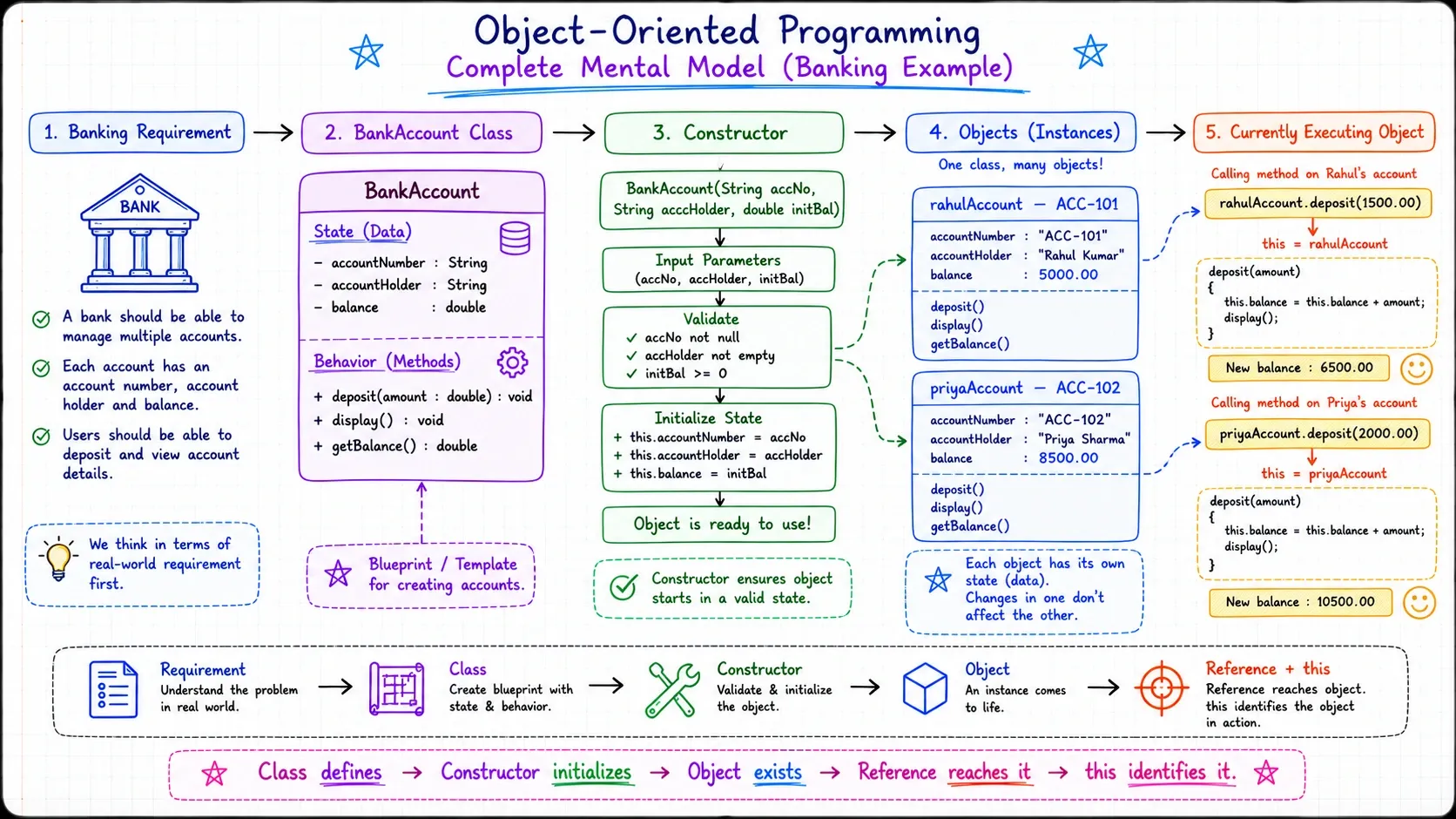
Keep this picture in mind as we examine each part.
1. 🧩 What Object-Oriented Programming Means
Object-Oriented Programming organizes a system around objects. Each object combines state with the behavior that operates on that state.
In our banking example:
- An account number, account holder, and balance represent state.
- Depositing money and displaying account details represent behavior.
- A
BankAccountclass describes what every bank-account object should contain and do.
This approach divides a large application into smaller, focused pieces that can collaborate.
Example
class BankAccount {

    // State: data remembered by each account object
    private String accountNumber;
    private String accountHolder;
    private double balance;

    BankAccount(
            String accountNumber,
            String accountHolder,
            double openingBalance
    ) {
        this.accountNumber = accountNumber;
        this.accountHolder = accountHolder;
        this.balance = openingBalance;
    }

    // Behavior: an operation performed by the account
    void deposit(double amount) {
        balance += amount;
    }

    void displayAccountInformation() {
        System.out.println(accountNumber + " | "
                + accountHolder + " | ₹" + balance);
    }
}InsightProduction note:
doublekeeps these introductory examples easy to read. Real financial applications normally useBigDecimalor an integer representing the smallest currency unit because binary floating-point values can introduce rounding errors.
Why OOP Helps
OOP can make a system:
- Modular: Each class owns a focused part of the problem.
- Reusable: One class definition can create many objects.
- Maintainable: Related state and behavior remain together.
- Scalable: New objects and behaviors can be added without duplicating the entire design.
Interview Understanding
- OOP models a system using objects that interact.
- An object combines state and behavior.
- Good OOP does not mean creating a class for everything; it means assigning clear responsibilities to useful abstractions.
2. 📋 Classes: The Reusable Definition
A class is a blueprint or template for creating objects. It defines the data an object can store and the actions it can perform.
Imagine that a bank wants to open thousands of accounts. Every account needs the same general structure, so writing separate code for every customer would make no sense. Instead, the bank defines one BankAccount class and creates many objects from it.
The class describes what a bank account should look like, but the class itself is not Rahul’s or Priya’s account. It is the reusable definition. 🏗️
🔑 Key Characteristics of a Class
- Fields or attributes: Store the state of an object. 📝
- Methods: Define the operations an object can perform. 🔧
- Constructors: Initialize new objects. 🛠️
- Reusability: One class can create many objects with different data. ♻️
Example
class BankAccount {

    // Fields define the structure and state.
    private String accountHolder;
    private String accountNumber;
    private double balance;

    // The constructor initializes a new object.
    BankAccount(
            String accountHolder,
            String accountNumber,
            double openingBalance
    ) {
        this.accountHolder = accountHolder;
        this.accountNumber = accountNumber;
        this.balance = openingBalance;
    }

    // Methods define behavior.
    void deposit(double amount) {
        balance += amount;
    }

    void displayAccountInformation() {
        System.out.println("Account holder: " + accountHolder);
        System.out.println("Account number: " + accountNumber);
        System.out.println("Balance: ₹" + balance);
    }
}
Here:
accountHolder,accountNumber, andbalanceare fields.deposit()anddisplayAccountInformation()are methods.BankAccount(...)is a constructor.
Why It Matters
Without a reusable class, developers would repeat the same fields and operations for every account. A class gives us one central definition that can be tested, maintained, and reused.
🎯 Interview Understanding
- A class is a definition, not an individual object.
- Fields represent state; methods represent behavior.
- One class can create any number of objects.
- A useful class normally has a clear and cohesive responsibility.
3. ⚡ Objects: Bringing the Class to Life
An object is a specific instance of a class. It follows the structure defined by its class but holds its own data.
Rahul’s account and Priya’s account can both be BankAccount objects. They support the same operations, yet each has its own account number, holder, and balance.
🔑 Key Characteristics of an Object
- State: The actual values held in its fields.
- Behavior: The methods it can execute.
- Identity: Its distinct identity as an object in memory.
- Reference: The value through which Java code reaches the object.
Example
public class Main {

    public static void main(String[] args) {
        BankAccount rahulAccount =
                new BankAccount("Rahul", "ACC-101", 10_000.00);

        BankAccount priyaAccount =
                new BankAccount("Priya", "ACC-102", 25_000.00);

        // The same method operates on two different objects.
        rahulAccount.deposit(2_000.00);
        priyaAccount.deposit(5_000.00);

        rahulAccount.displayAccountInformation();
        System.out.println();
        priyaAccount.displayAccountInformation();
    }
}

class BankAccount {

    private String accountHolder;
    private String accountNumber;
    private double balance;

    BankAccount(
            String accountHolder,
            String accountNumber,
            double openingBalance
    ) {
        this.accountHolder = accountHolder;
        this.accountNumber = accountNumber;
        this.balance = openingBalance;
    }

    void deposit(double amount) {
        balance += amount;
    }

    void displayAccountInformation() {
        System.out.println("Account holder: " + accountHolder);
        System.out.println("Account number: " + accountNumber);
        System.out.println("Balance: ₹" + balance);
    }
}
Output:
Account holder: Rahul
Account number: ACC-101
Balance: ₹12000.0

Account holder: Priya
Account number: ACC-102
Balance: ₹30000.0
Both objects use the same class definition and methods, but each method call operates on the state of its target object.
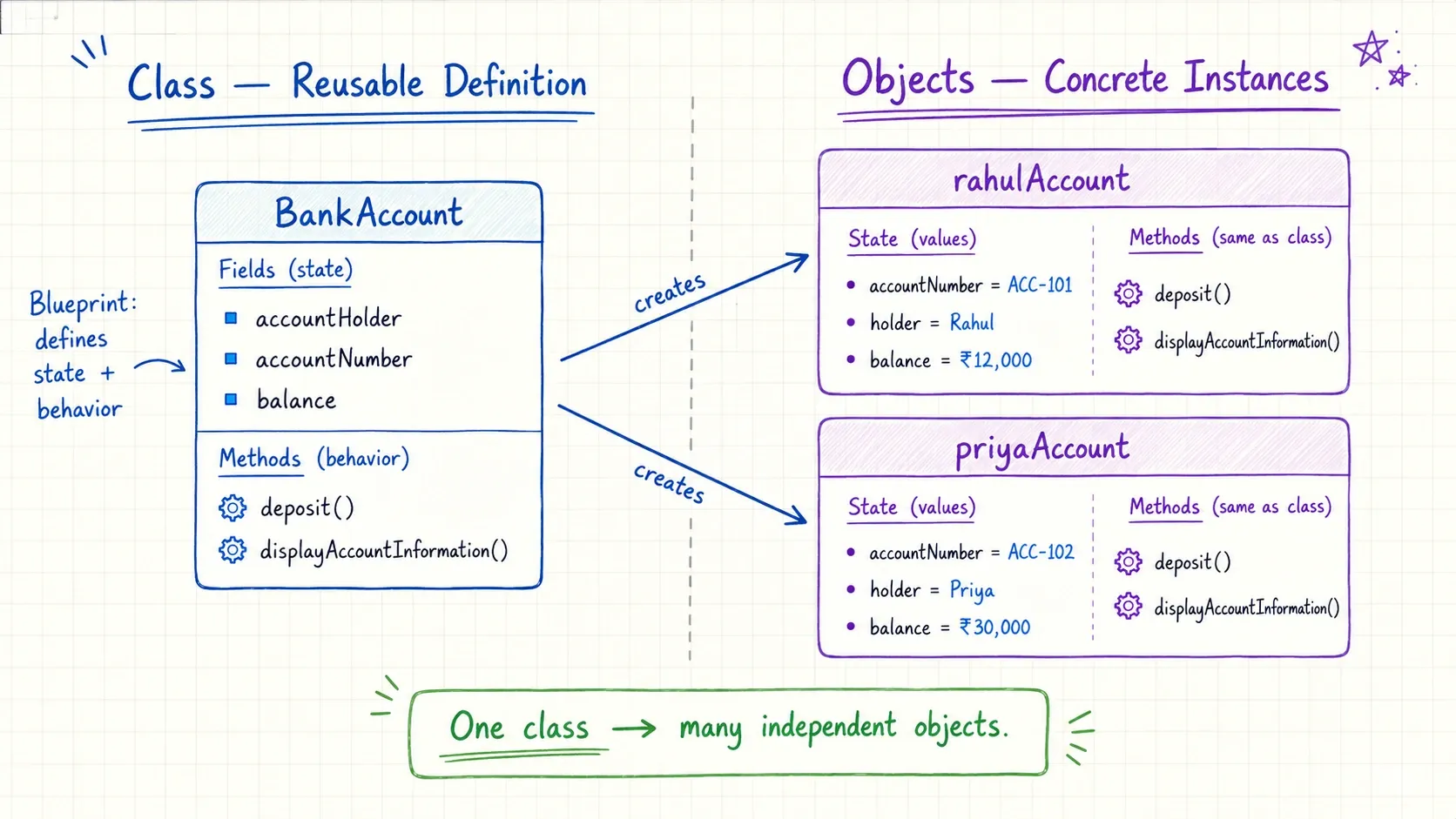
⚠️ Object Variables Hold References
Creating two reference variables does not necessarily create two objects.
BankAccount first =
        new BankAccount("Rahul", "ACC-101", 10_000.00);

// No new BankAccount object is created.
BankAccount second = first;
first and second now refer to the same object. A mutation through either reference is visible through the other.
first  ──┐
         ├──▶ One BankAccount object (ACC-101)
second ──┘
Why It Matters
A banking application can use one BankAccount class to represent thousands of account objects. Reference awareness matters because unintentionally sharing a mutable object can produce surprising changes elsewhere in the system.
Why Reference Awareness Matters?
- Shared Memory: Two variables can point to the exact same object in the computer memory.
- State Change: Changing a value through one variable changes it for all other variables pointing to that object.
- Side Effects: Code in one module updates a balance or status without telling other modules.
- Bug Creation: Other parts of the system read the new broken or unexpected data and fail.
How to Fix and Prevent Issues?
- Immutability: Make objects read-only so code cannot change values after creation.
- Defensive Copying: Return a new copy of an object instead of the original reference.
- Encapsulation: Hide internal data fields and control access through strict methods.
- Value Objects: Use objects defined by their data values rather than memory identity.
🎯 Interview Understanding
- A class is the blueprint; an object is an instance.
- Objects of the same class can hold different state.
- An instance method operates on the target object’s state.
- A reference variable does not contain the whole object.
- Two variables can point to the same object.
4. 🛠️ Constructors: Starting an Object Correctly
A constructor is a special declaration in a class that initializes an object during creation. It is invoked automatically as part of a new expression.
Its job is more important than simply assigning values. A well-designed constructor establishes the rules that must be true from the moment the object becomes available.
A constructor has the same name as its class and declares no return type, not even void.
🔑 Key Features of Constructors
- Automatic invocation: A matching constructor runs during object creation. 🔄
- No return type: A constructor does not declare a return type. 🚫
- Initialization: It assigns the object’s starting state. 🛠️
- Validation: It can reject invalid input. ✅
- Overloading: A class can offer several construction paths. 🔁
- Access control: A constructor can be
public,protected, package-private, orprivate. 🔐
Example: Enforcing Valid State
class BankAccount {

    private final String accountNumber;
    private final String accountHolder;
    private double balance;

    BankAccount(
            String accountNumber,
            String accountHolder,
            double openingBalance
    ) {
        if (accountNumber == null || accountNumber.isBlank()) {
            throw new IllegalArgumentException(
                    "Account number is required"
            );
        }

        if (accountHolder == null || accountHolder.isBlank()) {
            throw new IllegalArgumentException(
                    "Account holder is required"
            );
        }

        if (openingBalance < 0) {
            throw new IllegalArgumentException(
                    "Opening balance cannot be negative"
            );
        }

        this.accountNumber = accountNumber;
        this.accountHolder = accountHolder;
        this.balance = openingBalance;
    }

    void displayAccountDetails() {
        System.out.println(accountNumber + " | "
                + accountHolder + " | ₹" + balance);
    }
}
This constructor prevents an account from being created without an identity or with a negative opening balance.
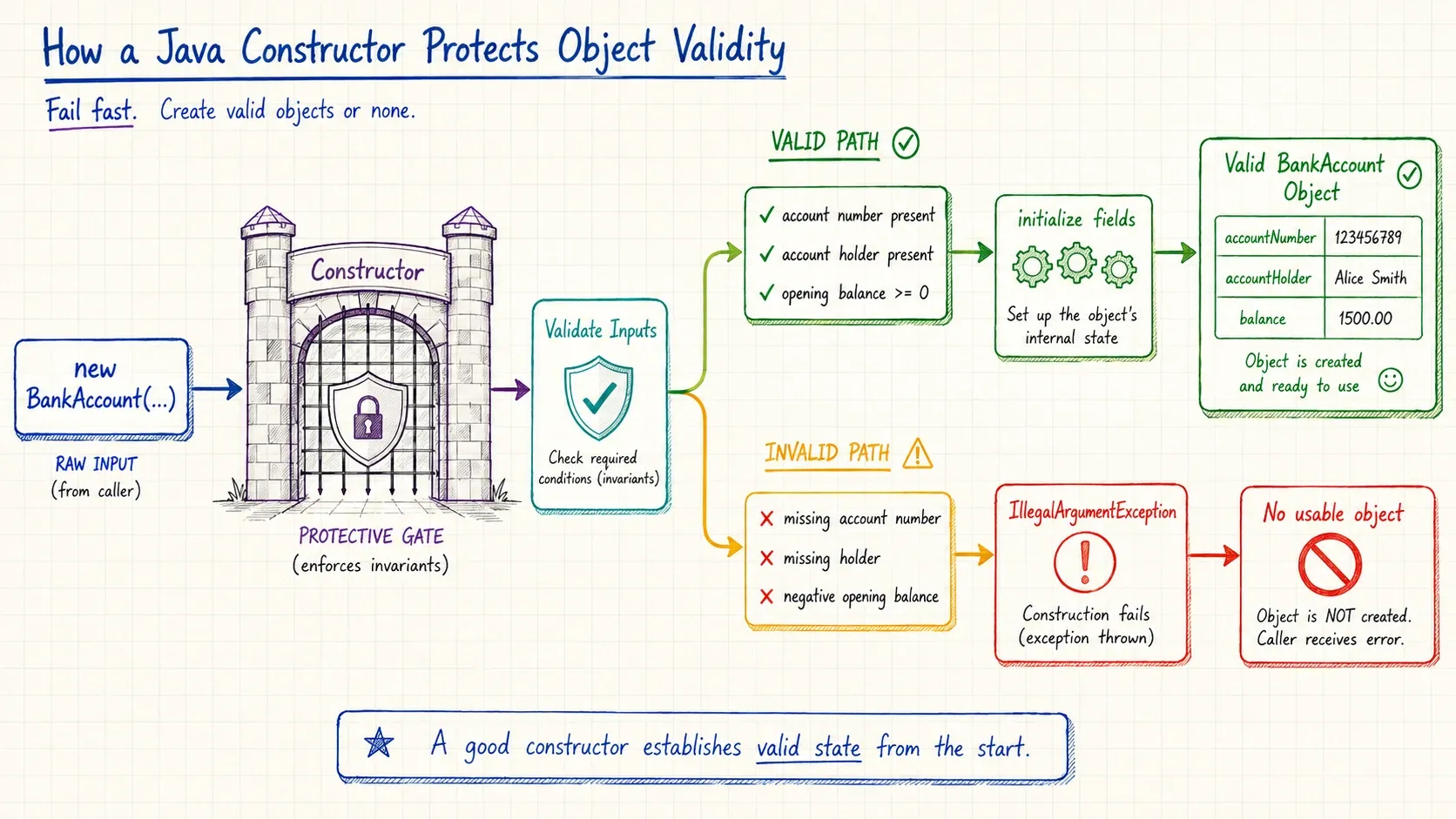
Why Constructors Matter
Constructors help make object creation:
- Consistent: Every object follows the same rules.
- Safe: Invalid input fails immediately.
- Readable: Required data is visible at the creation site.
- Maintainable: Initialization logic remains inside the owning class.
🎯 Interview Understanding
- A constructor initializes a new object; it is not a normal method.
- It has no declared return type.
- It can validate arguments and throw an exception.
- Constructor overloading provides multiple supported initialization paths.
5. 🔄 Types and Forms of Constructors
Java commonly uses these constructor forms:
| Constructor form | Who provides it? | Main purpose |
|---|---|---|
| Compiler-provided default constructor | Java compiler | Supplies a no-argument construction path when no constructor exists |
| User-defined no-argument constructor | Developer | Applies meaningful application defaults |
| Parameterized constructor | Developer | Accepts required initial data |
| Copy constructor | Developer | Creates a new object from another object’s data |
| Private constructor | Developer | Restricts and controls object creation |
Let’s examine them one by one.
5.1 Compiler-Provided Default Constructor
If a class declares no constructors, the Java compiler supplies a default constructor. For a normal class, it accepts no arguments and attempts to invoke the superclass’s no-argument constructor.
Before any constructor body executes, Java assigns standard default values to instance fields.
Default Values of Fields
byte,short,int, andlongreceive0.floatanddoublereceive0.0.booleanreceivesfalse.charreceives the null character\u0000.- Object references, including
String, receivenull.
These automatic values apply to instance and static fields, not to uninitialized local variables.
Example
class BankAccount {

    String accountHolder; // null
    double balance;       // 0.0
    boolean active;       // false

    /*
     * No constructor is declared.
     * The compiler supplies one similar to:
     *
     * BankAccount() {
     *     super();
     * }
     */
}

public class Main {

    public static void main(String[] args) {
        BankAccount account = new BankAccount();

        System.out.println("Account holder: " + account.accountHolder);
        System.out.println("Balance: " + account.balance);
        System.out.println("Active: " + account.active);
    }
}
Output:
Account holder: null
Balance: 0.0
Active: false
Java can create the object, but an account with no holder may not represent a meaningful business state.
⚠️ Default Constructor vs. No-Argument Constructor
A default constructor is specifically generated by the compiler.
A no-argument constructor is any constructor that accepts zero parameters. If a developer writes it, it is a user-defined no-argument constructor, not a compiler-provided default constructor.
This wording distinction is a common interview question.
5.2 User-Defined No-Argument Constructor
A user-defined no-argument constructor gives the developer control over the object’s initial state.
Example
class BankAccount {

    private String accountNumber;
    private String accountHolder;
    private double balance;
    private boolean active;

    BankAccount() {
        this.accountNumber = "UNASSIGNED";
        this.accountHolder = "Pending Customer";
        this.balance = 0.0;
        this.active = false;
    }

    void displayAccountDetails() {
        System.out.println("Account number: " + accountNumber);
        System.out.println("Account holder: " + accountHolder);
        System.out.println("Balance: ₹" + balance);
        System.out.println("Active: " + active);
    }
}
Now the object starts with explicit application values instead of null.
InsightUse this approach only when the chosen defaults represent a valid or intentionally pending business state. Required data should not be hidden behind convenient defaults.
5.3 Parameterized Constructor
A parameterized constructor accepts data from the caller and uses it to initialize the object.
Example
class BankAccount {

    private final String accountNumber;
    private final String accountHolder;
    private double balance;

    BankAccount(
            String accountNumber,
            String accountHolder,
            double openingBalance
    ) {
        if (accountNumber == null || accountNumber.isBlank()) {
            throw new IllegalArgumentException("Account number is required");
        }
        if (accountHolder == null || accountHolder.isBlank()) {
            throw new IllegalArgumentException("Account holder is required");
        }
        if (openingBalance < 0) {
            throw new IllegalArgumentException(
                    "Opening balance cannot be negative"
            );
        }

        this.accountNumber = accountNumber;
        this.accountHolder = accountHolder;
        this.balance = openingBalance;
    }
}
A parameterized constructor makes the required input visible at the call site:
BankAccount rahulAccount =
        new BankAccount("ACC-101", "Rahul", 10_000.00);

BankAccount priyaAccount =
        new BankAccount("ACC-102", "Priya", 25_000.00);
This is usually safer than creating an empty object and hoping that every required setter is called later.
5.4 Copy Constructor
A copy constructor creates a new object using data from another object of the same class.
Java does not generate copy constructors automatically. It is an ordinary constructor whose copying behavior is written by the developer.
Example
class BuildConfig {

    private String environment;
    private int timeoutSeconds;
    private boolean debugEnabled;

    BuildConfig(
            String environment,
            int timeoutSeconds,
            boolean debugEnabled
    ) {
        this.environment = environment;
        this.timeoutSeconds = timeoutSeconds;
        this.debugEnabled = debugEnabled;
    }

    // Copy constructor
    BuildConfig(BuildConfig other) {
        this.environment = other.environment;
        this.timeoutSeconds = other.timeoutSeconds;
        this.debugEnabled = other.debugEnabled;
    }

    void setEnvironment(String environment) {
        this.environment = environment;
    }

    void setDebugEnabled(boolean debugEnabled) {
        this.debugEnabled = debugEnabled;
    }

    String getEnvironment() {
        return environment;
    }

    boolean isDebugEnabled() {
        return debugEnabled;
    }
}BuildConfig production =
new BuildConfig("production", 300, false);
BuildConfig staging = new BuildConfig(production);
staging.setEnvironment("staging");
staging.setDebugEnabled(true);
System.out.println(production.getEnvironment()); // production
System.out.println(production.isDebugEnabled()); // false
System.out.println(staging.getEnvironment()); // staging
System.out.println(staging.isDebugEnabled()); // trueThe staging configuration starts with the same values as production, but it is a separate object. Changes made to the copied object do not modify the original object.
6. 🔗 Reference Assignment vs. Copy Construction
Reference assignment and object copying look similar, but they produce very different results.
BankAccount original =
        new BankAccount("ACC-101", "Rahul", 10_000.00);

// Reference assignment: no new object
BankAccount sameAccount = original;

// Copy construction: requires a BankAccount(BankAccount other)
// constructor, as shown in the shallow/deep copy examples below.
BankAccount copiedAccount = new BankAccount(original);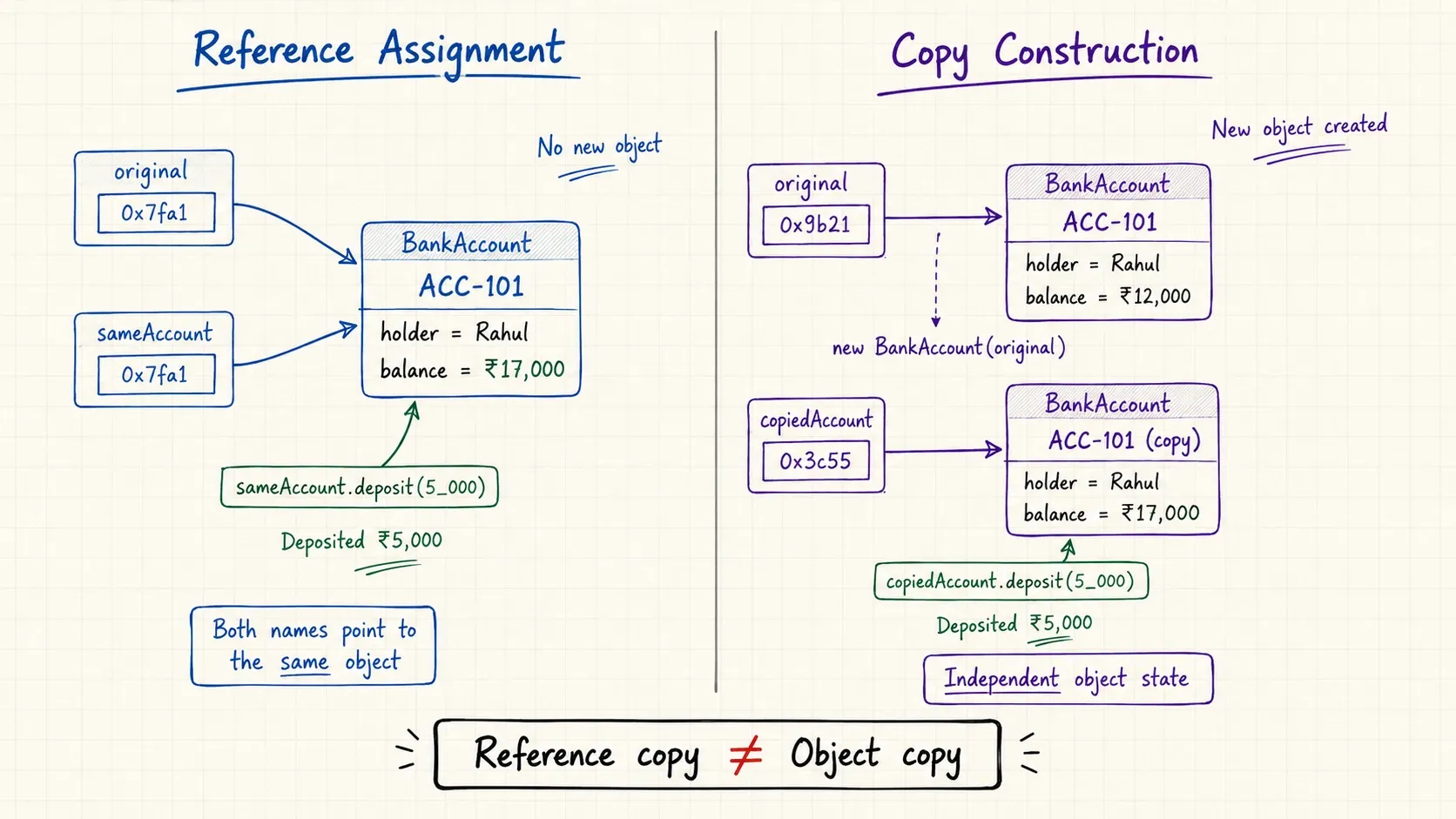
The Difference
| Operation | Creates a new object? | What is shared? | Effect of mutation |
|---|---|---|---|
BankAccount second = first; |
No | The same object | A change through either reference affects that object |
BankAccount second = new BankAccount(first); |
Yes | Whatever the copy constructor chooses to share | Can be independent if copying is implemented correctly |
Interview Understanding
- Java variables of class types hold reference values.
- Copying a reference does not clone an object.
- A copy constructor explicitly creates the new object.
- Java is always pass-by-value; for an object argument, the copied value is a reference.
7. 🪞 Shallow Copy vs Deep Copy
When an object contains another mutable object, copying becomes slightly more interesting.
The main question is:
InsightShould the original and copied object share the same nested object, or should each one get its own copy?
That is the difference between a shallow copy and a deep copy.
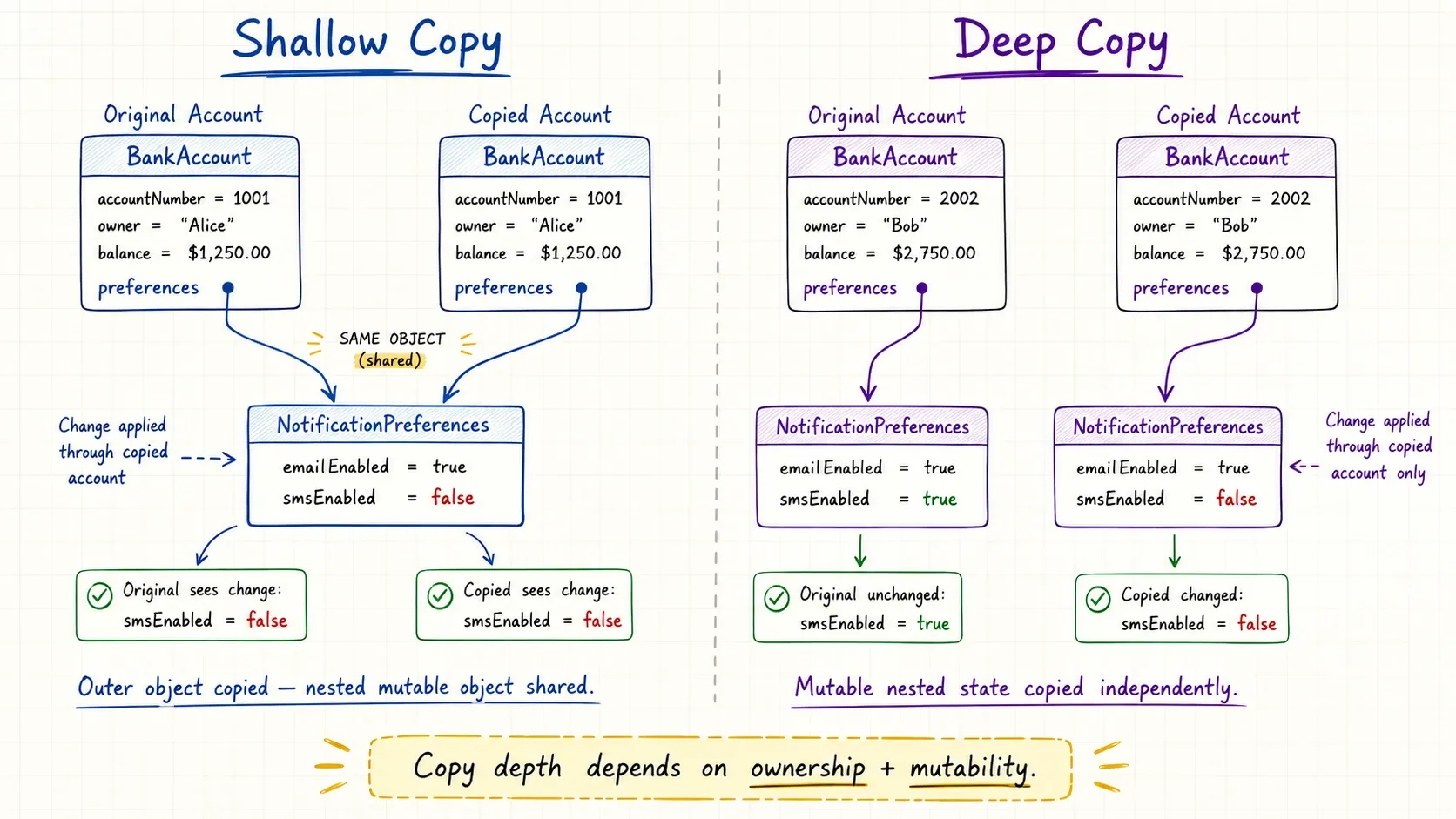
Shallow Copy
A shallow copy creates a new outer object, but it reuses the same nested object.
So the original and the copy are separate BankAccount objects, but both point to the same NotificationPreferences.
Example
class NotificationPreferences {

    private boolean smsEnabled;

    NotificationPreferences(boolean smsEnabled) {
        this.smsEnabled = smsEnabled;
    }

    void setSmsEnabled(boolean smsEnabled) {
        this.smsEnabled = smsEnabled;
    }

    boolean isSmsEnabled() {
        return smsEnabled;
    }
}

class BankAccount {

    private final String accountNumber;
    private final NotificationPreferences preferences;

    BankAccount(
            String accountNumber,
            NotificationPreferences preferences
    ) {
        this.accountNumber = accountNumber;
        this.preferences = preferences;
    }

    // Shallow-copy constructor
    BankAccount(BankAccount other) {
        this.accountNumber = other.accountNumber;

        // The same NotificationPreferences object is reused.
        this.preferences = other.preferences;
    }

    NotificationPreferences getPreferences() {
        return preferences;
    }
}

public class Main {

    public static void main(String[] args) {

        BankAccount original = new BankAccount(
                "ACC-101",
                new NotificationPreferences(true)
        );

        BankAccount copy = new BankAccount(original);

        copy.getPreferences().setSmsEnabled(false);

        System.out.println(
                original.getPreferences().isSmsEnabled()
        );

        System.out.println(
                copy.getPreferences().isSmsEnabled()
        );
    }
}
Output
false
false
Why did the original also become false?
Because both accounts share the same NotificationPreferences object.
original ──┐
           ├──> NotificationPreferences
copy ──────┘
Changing the preferences through copy changes the same object that original is using.
Easy way to remember
Shallow Copy
New outer object
Same inner object
Deep Copy
A deep copy creates a new outer object and also creates a separate copy of the nested mutable object.
Now the original and copied BankAccount objects each have their own NotificationPreferences.
Example
class NotificationPreferences {

    private boolean smsEnabled;

    NotificationPreferences(boolean smsEnabled) {
        this.smsEnabled = smsEnabled;
    }

    // Copy constructor for the nested object
    NotificationPreferences(NotificationPreferences other) {
        this.smsEnabled = other.smsEnabled;
    }

    void setSmsEnabled(boolean smsEnabled) {
        this.smsEnabled = smsEnabled;
    }

    boolean isSmsEnabled() {
        return smsEnabled;
    }
}

class BankAccount {

    private final String accountNumber;
    private final NotificationPreferences preferences;

    BankAccount(
            String accountNumber,
            NotificationPreferences preferences
    ) {
        this.accountNumber = accountNumber;
        this.preferences = preferences;
    }

    // Deep-copy constructor
    BankAccount(BankAccount other) {
        this.accountNumber = other.accountNumber;

        // A new NotificationPreferences object is created.
        this.preferences =
                new NotificationPreferences(other.preferences);
    }

    NotificationPreferences getPreferences() {
        return preferences;
    }
}

public class Main {

    public static void main(String[] args) {

        BankAccount original = new BankAccount(
                "ACC-101",
                new NotificationPreferences(true)
        );

        BankAccount copy = new BankAccount(original);

        copy.getPreferences().setSmsEnabled(false);

        System.out.println(
                original.getPreferences().isSmsEnabled()
        );

        System.out.println(
                copy.getPreferences().isSmsEnabled()
        );
    }
}
Output
true
false
This time, changing the copied account does not affect the original.
That is because each account has its own NotificationPreferences object.
original ───> NotificationPreferences(true)

copy ───────> NotificationPreferences(false)
Shallow Copy vs Deep Copy
| Shallow Copy | Deep Copy |
|---|---|
| Creates a new outer object | Creates a new outer object |
| Reuses nested object references | Copies nested mutable objects |
| Changes to shared nested objects can affect both copies | Changes remain independent |
| Usually simpler and cheaper | Requires additional copying |
The key idea is simple:
InsightShallow copy shares nested objects. Deep copy duplicates the nested mutable objects that should be independent.
🔑 Copying Rules to Remember
- Primitive values are copied directly.
- Immutable objects such as
Stringcan usually be shared safely. - Mutable nested objects may require independent copies.
- A copy constructor may perform a shallow or deep copy.
- The required copy depth depends on ownership and mutability.
- Deep-copying every object can be unnecessary and expensive.
Why It Matters in Backend Design
Unexpected sharing of mutable objects creates subtle bugs. A change to copied notification preferences should not silently change the original account’s configuration.
8. 🔐 Private Constructors and Controlled Object Creation
A private constructor cannot be called directly from outside its class. This gives the class control over when and how its objects are created.
Private constructors are commonly used with:
- static factory methods,
- Singleton implementations,
- cached or controlled object creation, and
- utility classes that should never be instantiated.
Example: One Bank Configuration Object
final class BankConfiguration {

    /*
     * Java's class-initialization rules make this eager
     * initialization thread-safe.
     */
    private static final BankConfiguration INSTANCE =
            new BankConfiguration();

    // Outside code cannot call new BankConfiguration().
    private BankConfiguration() {
    }

    static BankConfiguration getInstance() {
        return INSTANCE;
    }
}

public class Main {

    public static void main(String[] args) {
        BankConfiguration first =
                BankConfiguration.getInstance();

        BankConfiguration second =
                BankConfiguration.getInstance();

        System.out.println(first == second); // true
    }
}
Both variables refer to the same BankConfiguration object.
A good mental model is to separate three things: class loading, class initialization, and object creation.
1. Class Loading
   JVM reads BankConfiguration.class

2. Class Initialization
   JVM initializes static fields
   ↓
   INSTANCE = new BankConfiguration()

3. Object Creation
   new BankConfiguration() creates the actual object
When the class is used for the first time, such as:
BankConfiguration.getInstance();the JVM checks whether BankConfiguration has already been initialized.
If it has not, the JVM must initialize it before executing the static method normally.
Conceptually:
Thread A                         Thread B
   |                               |
   | getInstance()                 | getInstance()
   |                               |
   +---------- both reach ---------+
               class
            initialization
                 |
                 v
          JVM initialization
              mechanism
           /             \
          /               \
Thread A allowed       Thread B waits
to initialize
     |
     v
static fields initialized

INSTANCE =
new BankConfiguration()
     |
     v
class initialization
is complete
     |
     +------------------+
     |                  |
Thread A continues   Thread B continues
     |                  |
     v                  v
  INSTANCE           INSTANCE
The JVM specification guarantees that a class is initialized by only one thread at a time. Internally, you can think of the JVM as having an initialization lock associated with that class. One thread performs the initialization; other threads trying to initialize that same class wait until it finishes.
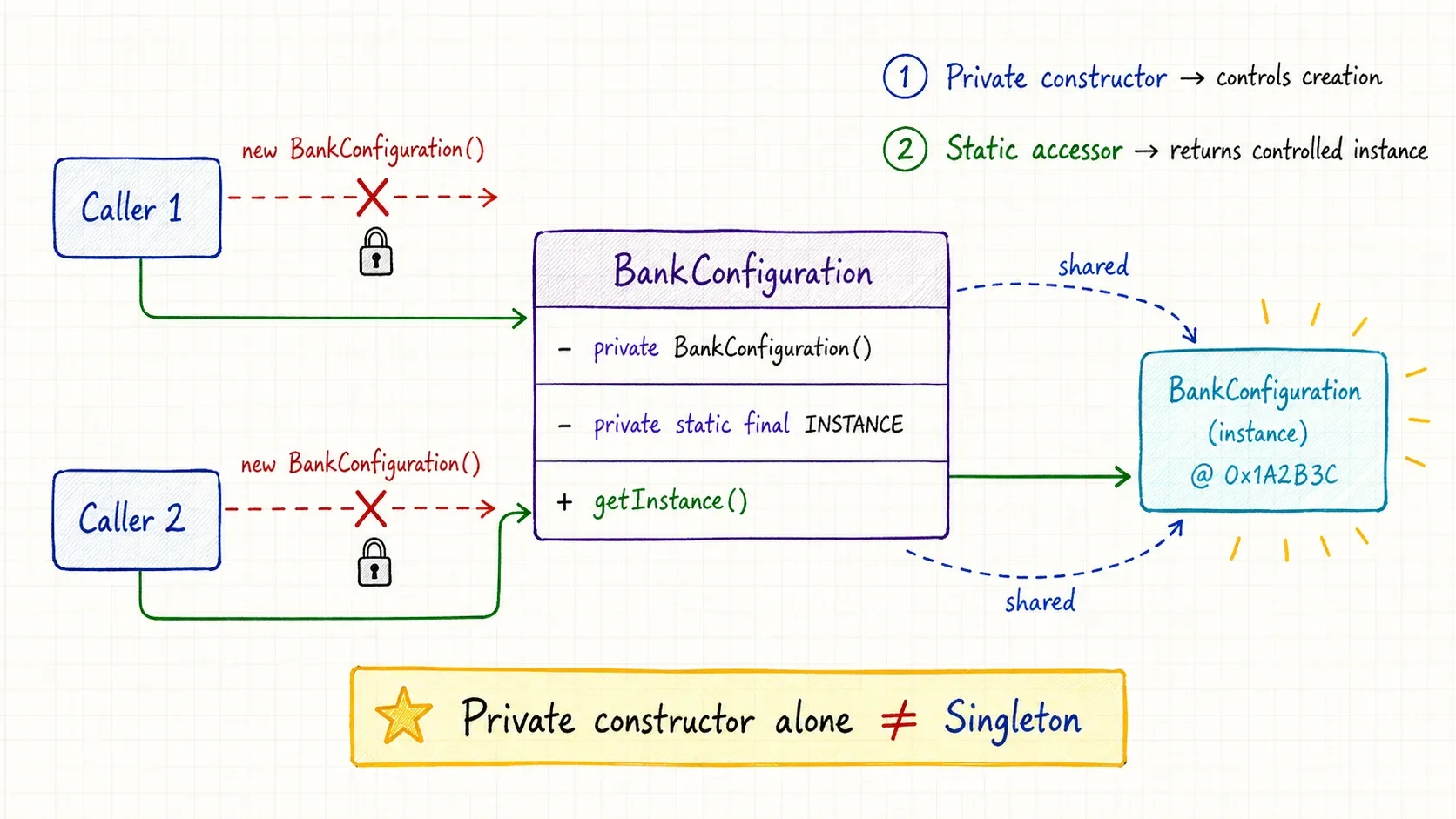
A Private Constructor Does Not Automatically Make a Class Singleton
A private constructor only means that other classes cannot create objects using new.
To make a class a Singleton, it must also:
- keep one instance of itself,
- provide a method to access that instance,
- always return the same instance, and
- make sure multiple threads cannot accidentally create multiple instances (thread safety).
Simple idea:
InsightPrivate constructor = controls object creation.
Singleton = controls object creation and guarantees only one shared instance.
Why It Matters
Controlled construction is useful when creation requires restrictions, naming, caching, reuse, or special validation. It should not be used merely to make every object globally available.
🎯 Interview Understanding
- A private constructor blocks direct construction from outside the class.
- A static access method works before any caller-owned instance exists.
- The access method may create, cache, or return an existing object.
- A private constructor by itself does not guarantee a Singleton.
9. 🔁 Constructor Overloading
Constructor overloading means defining multiple constructors in the same class with different parameter lists.
Java selects the matching constructor using the number, types, and order of the supplied arguments.
Example
class BankAccount {

    private String accountNumber;
    private String accountHolder;
    private double balance;

    BankAccount() {
        this("UNASSIGNED", "Pending Customer", 0.0);
    }

    BankAccount(
            String accountNumber,
            String accountHolder
    ) {
        this(accountNumber, accountHolder, 0.0);
    }

    BankAccount(
            String accountNumber,
            String accountHolder,
            double openingBalance
    ) {
        this.accountNumber = accountNumber;
        this.accountHolder = accountHolder;
        this.balance = openingBalance;
    }
}
These constructor signatures are different:
BankAccount()
BankAccount(String, String)
BankAccount(String, String, double)
The following pair is illegal because parameter names are not part of a constructor signature:
class InvalidBankAccount {

    InvalidBankAccount(String accountNumber) {
    }

    /*
     * Compilation error: this has the same signature.
     *
     * InvalidBankAccount(String accountHolder) {
     * }
     */
}
🔑 Key Points
- The constructor name always matches the class name.
- The number, types, or order of parameters must differ.
- Changing only parameter names does not create another signature.
- Overload selection happens at compile time.
- Return type cannot distinguish constructors because constructors declare no return type.
10. 🔗 Constructor Chaining with this(...)
Constructor chaining allows one constructor to delegate to another constructor in the same class using this(...).
This avoids repeated initialization and keeps validation in one central place.
Example
class BankAccount {

    private final String accountNumber;
    private final String accountHolder;
    private double balance;

    BankAccount(
            String accountNumber,
            String accountHolder
    ) {
        // Delegates to the three-argument constructor.
        this(accountNumber, accountHolder, 0.0);
    }

    BankAccount(
            String accountNumber,
            String accountHolder,
            double openingBalance
    ) {
        if (openingBalance < 0) {
            throw new IllegalArgumentException(
                    "Opening balance cannot be negative"
            );
        }

        this.accountNumber = accountNumber;
        this.accountHolder = accountHolder;
        this.balance = openingBalance;
    }
}
Rules to Remember
this(...)invokes another constructor in the same class.- Java chooses the target using the arguments supplied.
- These examples put
this(...)orsuper(...)first to keep constructor flow easy to follow. - A constructor chain cannot form a cycle.
- A constructor cannot directly invoke both
this(...)andsuper(...)as constructor-invocation statements.
Why It Matters
Constructor chaining supports DRY, or Don’t Repeat Yourself. Centralizing validation and field assignment prevents overloaded constructors from applying different rules accidentally.
InsightJava version note: Java 25 supports flexible constructor bodies. Certain safe statements, such as argument validation, may appear before
this(...)orsuper(...). The first-statement style used here remains valid. See Oracle’s guide to flexible constructor bodies.
11. 👨👦 Superclass and Subclass Construction
In the examples below, the subclass calls super(...) first. The superclass constructor finishes, then execution continues with the remaining statements in the subclass constructor. Java 25 also allows a restricted prologue before that call, as explained in the version note above.
A subclass does not inherit superclass constructors. It can invoke an accessible superclass constructor using super(...).
Example
class BankAccount {

    private final String accountNumber;

    BankAccount(String accountNumber) {
        this.accountNumber = accountNumber;
        System.out.println(
                "BankAccount constructor: " + accountNumber
        );
    }
}

class SavingsAccount extends BankAccount {

    private final double interestRate;

    SavingsAccount(
            String accountNumber,
            double interestRate
    ) {
        // The superclass portion is initialized first.
        super(accountNumber);

        this.interestRate = interestRate;
        System.out.println(
                "SavingsAccount constructor: "
                        + interestRate + "%"
        );
    }
}

public class Main {

    public static void main(String[] args) {
        new SavingsAccount("ACC-101", 6.5);
    }
}
Output:
BankAccount constructor: ACC-101
SavingsAccount constructor: 6.5%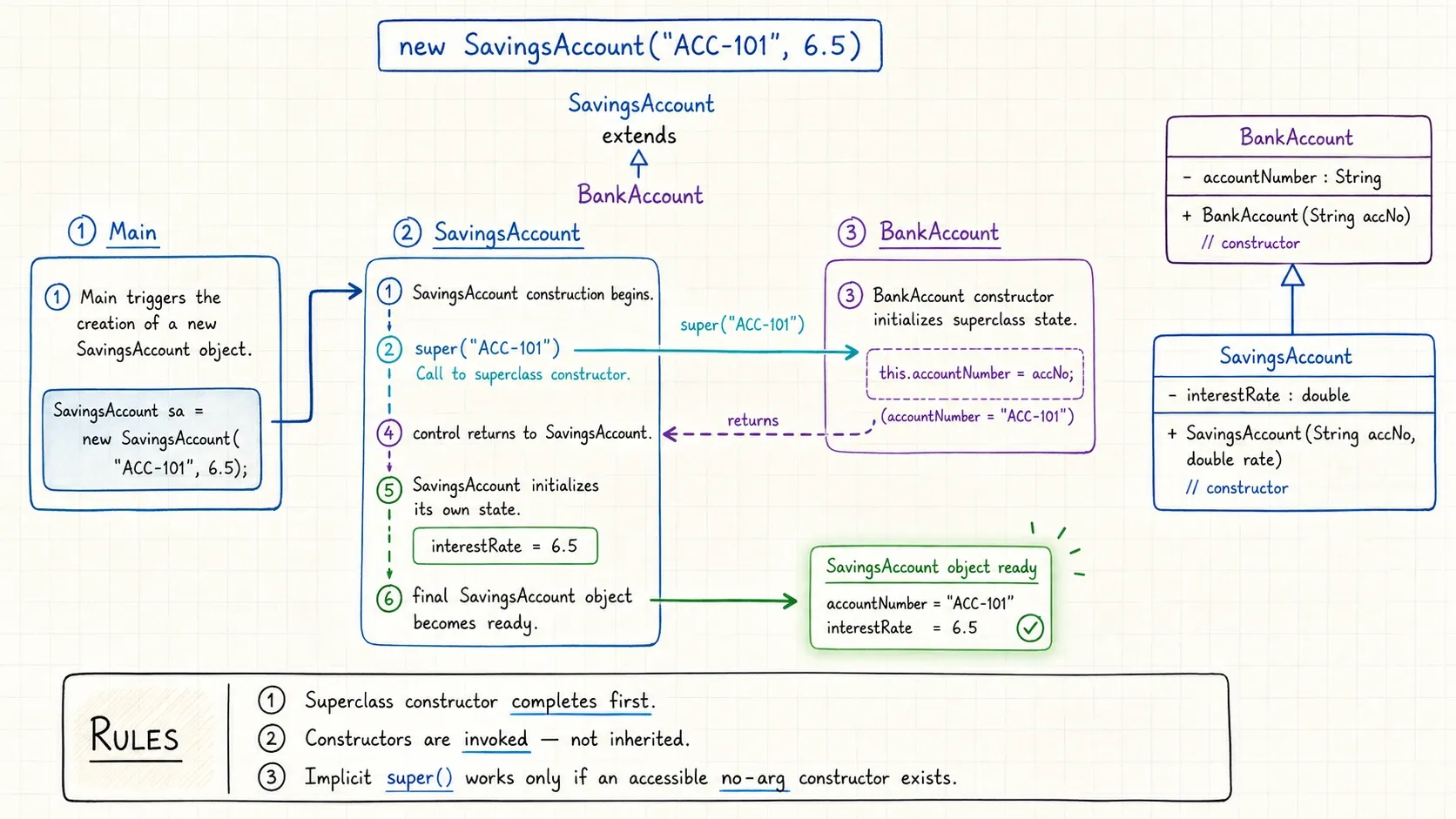
What If super(...) Is Not Written?
When a subclass object is created, Java must initialize the superclass part first.
If you do not explicitly write either this(...) or super(...) inside the subclass constructor, Java automatically tries to insert:
super();For example:
class BankAccount {

    BankAccount(String accountNumber) {
    }
}

class SavingsAccount extends BankAccount {

    SavingsAccount(String accountNumber) {
        // Java tries to insert:
        // super();
    }
}
This causes a compilation error because BankAccount does not have a no-argument constructor:
BankAccount() {
}
It only has:
BankAccount(String accountNumber) {
}
So the subclass must explicitly call the available superclass constructor:
class BankAccount {

    BankAccount(String accountNumber) {
    }
}

class SavingsAccount extends BankAccount {

    SavingsAccount(String accountNumber) {
        super(accountNumber);
    }
}
Easy Rule to Remember
InsightIf you write neither
this(...)norsuper(...), Java automatically triessuper().
This works only when the superclass has an accessible no-argument constructor.
If the superclass only provides constructors with parameters, the subclass must explicitly call one of them using:
super(arguments);🔑 Key Points
- The superclass constructor completes first.
- The statements after
super(...)run afterward. - Constructors are not inherited and cannot be overridden.
super(...)invokes an accessible superclass constructor.- An implicit
super()works only when an accessible no-argument superclass constructor exists.
12. 🚫 Constructor Modifier Rules
Constructors can use access modifiers, but Java does not allow them to be declared final, static, abstract, or synchronized.
class BankAccount {

    // Valid: constructors may be private.
    private BankAccount() {
    }
}

/*
 * These constructor declarations are illegal:
 *
 * final BankAccount() { }
 * static BankAccount() { }
 * abstract BankAccount();
 * synchronized BankAccount() { }
 */
Why can a constructor not be final?
final is used to prevent a method from being overridden by a subclass.
Constructors are never inherited and never overridden. A subclass always has its own constructor, even if it calls a superclass constructor.
Therefore, marking a constructor as final would serve no purpose.
Why can a constructor not be static?
A static member belongs to the class and does not need an object.
A constructor exists specifically to initialize a new object being created.
So their purposes conflict: static means no particular object is required, while a constructor always works with a particular new object.
Why can a constructor not be abstract?
An abstract method has no implementation and expects a subclass to provide one.
Constructors do not work through overriding. A subclass constructor does not implement or override a superclass constructor.
Also, every constructor that runs must perform real initialization for its own class.
Therefore, an abstract constructor would not fit Java’s constructor model.
Why can a constructor not be synchronized?
synchronized is used to control concurrent access to a method or block of code that works with shared state.
A constructor is part of creating a new object. Java does not allow the synchronized modifier directly on a constructor declaration.
If multiple threads need controlled access to object creation, synchronization should happen around the code that decides when or how the object is created.
For example, the control can happen through:
- safe static initialization,
- a synchronized factory method,
- or explicit locking around shared creation logic.
InsightPrecise interview answer: A Java constructor cannot be declared
final,static,abstract, orsynchronized.
13. ⚠️ Declaring Any Constructor Removes the Compiler-Provided Constructor
As soon as a class declares any constructor, the compiler no longer supplies its default constructor.
If callers still need no-argument construction, the developer must declare that path explicitly.
Example
class BankAccount {

    private final String accountNumber;

    BankAccount(String accountNumber) {
        this.accountNumber = accountNumber;
    }
}

public class Main {

    public static void main(String[] args) {
        BankAccount first =
                new BankAccount("ACC-101");

        /*
         * Compilation error: BankAccount() does not exist.
         *
         * BankAccount second = new BankAccount();
         */
    }
}
If both paths are required, define both:
class BankAccount {

    private final String accountNumber;

    BankAccount() {
        this("UNASSIGNED");
    }

    BankAccount(String accountNumber) {
        this.accountNumber = accountNumber;
    }
}
Interview Understanding
- A parameterized constructor does not preserve an automatic no-argument constructor.
- The compiler adds a default constructor only when no constructor is declared.
- Add an explicit no-argument constructor when the application or framework genuinely needs one.
14. ↩️ Using return Inside a Constructor
A constructor cannot return a value, but it may contain a bare return; statement to exit early.
Although legal, early return can leave an object with default or incomplete field values.
Example
class BankTransaction {

    private double amount; // Starts as 0.0

    BankTransaction(double amount) {
        if (amount < 0) {
            System.out.println("Invalid transaction amount");
            return; // Legal, but the object is still created.
        }

        this.amount = amount;
    }

    double getAmount() {
        return amount;
    }
}

public class Main {

    public static void main(String[] args) {
        BankTransaction validTransaction =
                new BankTransaction(500.00);

        BankTransaction invalidTransaction =
                new BankTransaction(-500.00);

        System.out.println(validTransaction.getAmount());
        System.out.println(invalidTransaction.getAmount());
    }
}
Output:
Invalid transaction amount
500.0
0.0
The second object still exists, but its amount remains at the default value 0.0.
A safer design normally rejects creation explicitly:
class BankTransaction {

    private final double amount;

    BankTransaction(double amount) {
        if (amount < 0) {
            throw new IllegalArgumentException(
                    "Transaction amount cannot be negative"
            );
        }

        this.amount = amount;
    }
}
Why It Matters
A bare return; can hide an initialization failure. Throwing an exception makes it clear that construction did not succeed with the supplied input.
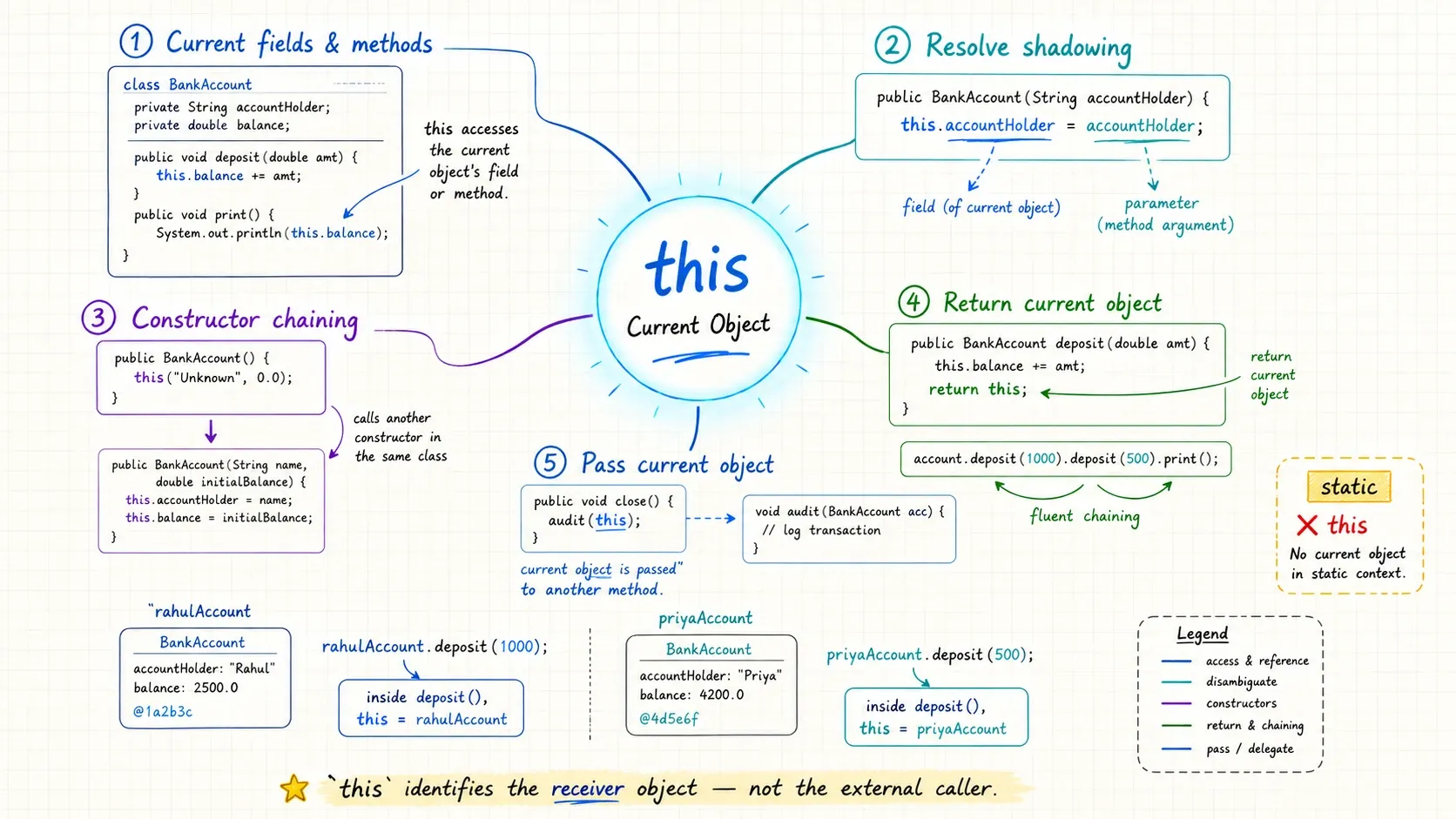
15. ⚙️ The this Keyword: Identifying the Current Object
Inside an instance constructor or method, this refers to the current object, meaning the object on which the constructor or method is executing.
Suppose we call:
rahulAccount.deposit(500.00);Inside deposit(), this refers to the object reached through rahulAccount. If we call the same method on priyaAccount, this refers to Priya’s account instead.
This is what allows one method definition to work with many different objects.
🔑 Common Uses of this
- Accessing the current object’s fields and methods
- Resolving conflicts between fields and parameters
- Invoking another constructor with
this(...) - Returning the current object for method chaining
- Passing the current object to another method
15.1 Accessing the Current Object
this.field explicitly accesses a field that belongs to the current object.
Example
class BankAccount {

    private String accountHolder;
    private double balance;

    BankAccount(
            String accountHolder,
            double balance
    ) {
        this.accountHolder = accountHolder;
        this.balance = balance;
    }

    void displayAccountDetails() {
        System.out.println(
                "Account holder: " + this.accountHolder
        );
        System.out.println(
                "Balance: ₹" + this.balance
        );
    }
}
this.accountHolder and this.balance belong to whichever BankAccount object receives the method call.
15.2 Resolving Name Conflicts
A parameter or local variable can have the same name as an instance field. In that situation, the nearer variable shadows the field.
this removes the ambiguity.
Example
class BankAccount {

    private String accountHolder;

    BankAccount(String accountHolder) {
        // Current object's field = constructor parameter
        this.accountHolder = accountHolder;
    }
}
The two sides mean different things:
this.accountHolderis the instance field.accountHolderis the constructor parameter.
Without this, the following statement would assign the parameter to itself and leave the field unchanged:
accountHolder = accountHolder;15.3 Calling Another Constructor
this(...) calls another constructor in the same class. This is the constructor chaining we saw earlier.
Example
class BankAccount {

    private final String accountNumber;
    private final String accountHolder;
    private double balance;

    BankAccount(
            String accountNumber,
            String accountHolder
    ) {
        this(accountNumber, accountHolder, 0.0);
    }

    BankAccount(
            String accountNumber,
            String accountHolder,
            double openingBalance
    ) {
        this.accountNumber = accountNumber;
        this.accountHolder = accountHolder;
        this.balance = openingBalance;
    }
}
Do not confuse the two forms:
thisis the current-object reference.this(...)is an explicit invocation of another constructor in the same class.
15.4 Returning the Current Object
An instance method can return this. The caller can then invoke another method on the same object, producing a fluent interface or method chain. 🔗
Example
class AccountOpeningRequest {

    private String accountHolder;
    private String accountType;
    private double initialDeposit;

    AccountOpeningRequest setAccountHolder(
            String accountHolder
    ) {
        this.accountHolder = accountHolder;
        return this;
    }

    AccountOpeningRequest setAccountType(
            String accountType
    ) {
        this.accountType = accountType;
        return this;
    }

    AccountOpeningRequest setInitialDeposit(
            double initialDeposit
    ) {
        this.initialDeposit = initialDeposit;
        return this;
    }

    void displayRequest() {
        System.out.println(accountHolder + " | "
                + accountType + " | ₹" + initialDeposit);
    }
}

public class Main {

    public static void main(String[] args) {
        AccountOpeningRequest request =
                new AccountOpeningRequest()
                        .setAccountHolder("Rahul")
                        .setAccountType("Savings")
                        .setInitialDeposit(10_000.00);

        request.displayRequest();
    }
}
Output:
Rahul | Savings | ₹10000.0Method chaining can make object configuration easy to read. Very long chains, however, can be harder to debug.
15.5 Passing the Current Object to Another Method
The current object can be passed to another method by supplying this as an argument.
Example
class AccountAuditService {

    static void audit(BankAccount account) {
        System.out.println(
                "Auditing account: "
                        + account.getAccountNumber()
        );
    }
}

class BankAccount {

    private final String accountNumber;

    BankAccount(String accountNumber) {
        this.accountNumber = accountNumber;
    }

    String getAccountNumber() {
        return accountNumber;
    }

    void requestAudit() {
        // Passes the current BankAccount object.
        AccountAuditService.audit(this);
    }
}

public class Main {

    public static void main(String[] args) {
        BankAccount account =
                new BankAccount("ACC-101");

        account.requestAudit();
    }
}
Output:
Auditing account: ACC-101⚠️ Java Is Still Pass-by-Value
Passing this does not make Java pass-by-reference.
Java always passes arguments by value. For an object argument, the value being copied is a reference. The original and copied references reach the same object, but the reference value itself was passed by value.
What Is Pass by Value?
InsightA method receives a copy of the value stored in the caller’s variable. Changing the method parameter does not replace the caller’s variable.
Primitive Types
For primitive types (int, double, boolean, char), Java passes a copy of the actual value.
number = 10

   copy

value = 10
If the method changes:
value = 20the caller still has:
number = 10because only the copied value was changed.
What Happens With Objects?
An object variable stores a reference to an object in java.
When an object is passed to a method, Java copies the reference value.
Caller reference        Method parameter

      |                       |
      +----------+------------+
                 |
                 v
           Same Object
Both references point to the same object, so changes made to the object’s state are visible to the caller.
If the method changes object fields, the caller sees the change because both references point to the same object.
Reassigning the Method Parameter
If the method does:
bankAccount = new BankAccount("XYZ");only the method’s copied reference changes.
Before:
Caller variable          Method parameter

account                  bankAccount

      \                    /
       \                  /
        v                v

          Original Object
After:
Caller variable          Method parameter

account                  bankAccount

   |                         |
   v                         v

Original Object          New Object
The caller still points to the original object because only the local copy of the reference was changed.
Notes:
When we pass an object as a method parameter in Java, a copy of the object reference is passed, not the actual object itself. Since both the caller’s reference and the method parameter reference point to the same object, any changes made to the object’s internal state are visible to the caller as well. This behavior often makes people think that Java uses pass-by-reference.
However, Java is still pass-by-value. The proof is what happens when we reassign the method parameter:
void updateAccount(BankAccount bankAccount) {
    bankAccount = new BankAccount("XYZ");
}
Here, only the method’s local copy of the reference is changed to point to a new object. The caller’s original reference is still pointing to the original BankAccount object, so the caller does not see this reassignment.
This shows that Java does not pass the actual reference variable itself. It only passes a copy of the reference value. The copied reference can modify the same object, but changing where that reference points affects only the local method scope. Therefore, Java is pass-by-value, where the value being copied can be an object reference.
Why Can People Think Java Is Pass by Reference?
People often think Java uses pass by reference because when an object is modified inside a method, the caller can see those changes. This happens because Java passes a copy of the object reference, and both the original reference and the copied reference point to the same object.
However, Java is still pass by value. The value being copied is the reference itself, not the actual object. Since both references can access the same object, changes made to the object’s internal state are visible to the caller. But if the method changes the reference to point to a completely new object, only the method’s local copy is updated, and the caller’s original reference remains unchanged.
Therefore, the correct statement is:
InsightJava passes object references by value.
Final Takeaway
Java is always pass by value. For primitive types, the actual value is copied. For objects, the reference value is copied. Since copied references can point to the same object, a method can modify that object’s state, but it cannot change where the caller’s original reference points.
InsightJava does not pass objects by reference. Java passes a copy of the object’s reference by value.
16. 🚫 Why this Cannot Be Used in a Static Context
A static method belongs to the class rather than to one particular object. Because it can execute without any BankAccount instance, no current object exists for this to identify.
Example
class BankAccount {

    private String accountHolder;

    BankAccount(String accountHolder) {
        this.accountHolder = accountHolder;
    }

    void displayAccountHolder() {
        // Valid: this instance method has a receiver object.
        System.out.println(this.accountHolder);
    }

    static void displayBankName() {
        System.out.println("OpenAI Bank");

        /*
         * Compilation error: no current BankAccount exists.
         *
         * System.out.println(this.accountHolder);
         */
    }
}
Explanation
thisrefers to the current instance.- A static method is associated with the class.
- Static code can run without a current instance.
- Therefore,
thisis unavailable in a static context. - Static code must receive an object explicitly when it needs instance data.
17. 👍 Benefits and Risks of this
Benefits
1. Improves Clarity
this.accountHolder makes it explicit that the code is accessing the current object’s field.
2. Resolves Variable Shadowing
It distinguishes an instance field from a parameter or local variable with the same name.
3. Enables Constructor Chaining
this(...) allows constructors to reuse centralized initialization logic.
4. Enables Fluent Method Chaining
Returning this allows several related operations to be expressed as one readable chain.
5. Passes the Current Object to a Collaborator
Another method or service can inspect or process the current object.
Limitations and Risks
1. No Static Context
this cannot be used where no receiver object exists.
2. Overuse Can Add Noise
Using this everywhere, even when there is no ambiguity, can make straightforward code unnecessarily verbose.
3. Long Chains Can Be Hard to Debug
Fluent APIs are useful, but excessively long chains can hide which operation caused a failure.
4. Letting this Escape During Construction Is Dangerous
Passing this from a constructor can expose the object before all of its fields have been initialized. Another thread or collaborator may observe partially constructed state.
Avoid publishing this, registering listeners, or starting asynchronous work from a constructor unless the lifecycle is carefully controlled.
18. 🧠 LLD Design Lessons Hidden in These Basics
Classes, objects, constructors, and this may look like Java fundamentals, but they express several important design ideas.
Encapsulation: Protect Valid State
Keep fields private and expose meaningful operations. An account should provide deposit() instead of allowing any caller to assign an arbitrary balance.
High Cohesion: Keep Related Responsibilities Together
Account state and account behavior naturally belong in BankAccount. Unrelated responsibilities, such as sending emails, should live in a separate collaborator.
DRY: Centralize Initialization
Use constructor chaining to keep validation and field assignment in one place.
KISS: Prefer the Simplest Valid Construction Path
Do not introduce a factory, builder, or Singleton when a clear public constructor is sufficient.
Fail Fast: Reject Invalid Objects Early
If an account cannot be valid without an account number, reject the missing value in the constructor instead of allowing a broken object to travel through the system.
Controlled Creation: Use Private Constructors Intentionally
Private constructors are useful when creation must be restricted. They are a design decision, not a default style.
Practical Design Pattern Connections
The material naturally connects to a few patterns:
- Builder: Often returns
thisto create a fluent object-construction API. - Static factory method: A named static method can clarify or control object creation. This is different from the GoF Factory Method pattern, which lets subclasses vary the object being created.
- Singleton: Combines restricted construction with controlled access to one instance.
Patterns solve particular design problems. Do not force them into a design that does not need them.
19. 🎤 Interview Questions and Model Answers
Use these questions to practise saying the answer aloud. In an interview, begin with the direct answer and then give the reason.
🟢 Beginner Questions
1. What is a constructor in Java?
A constructor is a special declaration in a class that initializes a newly created object. It has the same name as its class, declares no return type, and runs as part of object creation.
2. Is a constructor a normal method?
No. A constructor looks similar to a method, but it is used during initialization, has no declared return type, is not inherited, and cannot be overridden.
3. What is the difference between a default constructor and a no-argument constructor?
A default constructor is generated by the compiler when no constructor is declared. A no-argument constructor is any constructor with zero parameters and may be written explicitly by the developer.
4. Does Java always provide a default constructor?
No. The compiler provides one only when the class declares no constructors.
5. What happens if a class declares only a parameterized constructor?
The compiler does not add a no-argument constructor. Calling new BankAccount() fails to compile unless BankAccount() is explicitly declared.
class BankAccount {

    BankAccount(String accountNumber) {
    }
}

/*
 * Compilation error:
 * BankAccount account = new BankAccount();
 */
6. Can a class have multiple constructors?
Yes. Constructors can be overloaded using different parameter lists. The number, types, or order of parameters must differ; changing only parameter names is not enough.
7. Can constructors be overloaded or overridden?
Constructors can be overloaded, but they cannot be overridden because they are not inherited.
8. What does this mean in Java?
this refers to the current receiver object, meaning the object on which the instance constructor or method is executing.
9. Why do we write this.accountHolder = accountHolder?
The parameter shadows the field. this.accountHolder selects the current object’s field, while accountHolder refers to the parameter.
10. Can this be used in a static method?
No. A static method has no current receiver object, so no this reference exists.
🟡 Intermediate Questions
11. Can a constructor be private?
Yes. A private constructor restricts direct external construction. It is useful for controlled factories, Singleton implementations, and non-instantiable utility classes.
12. Are constructors inherited?
No. A subclass can invoke an accessible superclass constructor using super(...), but it does not inherit that constructor.
13. Which constructor runs first when a subclass object is created?
For the first-statement style used here, the superclass constructor completes first, then the remaining statements in the subclass constructor run.
14. What happens when super(...) is not written explicitly?
Java normally attempts an implicit super(). Compilation fails if the superclass has no accessible no-argument constructor.
15. Can a constructor return a value?
No. A constructor cannot return a value. It may contain a bare return; to exit early, but that can leave the object in an unclear state.
16. Is an early return; inside a constructor recommended?
Usually not. Throwing an exception is generally clearer when input is invalid because it prevents the caller from receiving an incompletely initialized object.
17. What is a copy constructor?
It is a developer-defined constructor that accepts another object of the same class and initializes a new object from its data. Java does not generate it automatically.
18. Does a copy constructor always perform a deep copy?
No. It performs exactly the copying logic written by the developer. Nested mutable objects may be shared in a shallow copy or duplicated in a deep copy.
19. What is the difference between reference assignment and copy construction?
Reference assignment creates another reference to the same object:
BankAccount second = first;Copy construction creates a new object:
BankAccount second = new BankAccount(first);20. What is the difference between this and this(...)?
this refers to the current object. this(...) invokes another constructor in the same class.
21. What is the difference between this(...) and super(...)?
this(...) delegates to another constructor in the same class. super(...) invokes a constructor in the superclass.
22. How does this support method chaining?
An instance method can return this, allowing another method to be called on the same object.
AccountOpeningRequest request =
        new AccountOpeningRequest()
                .setAccountHolder("Rahul")
                .setAccountType("Savings")
                .setInitialDeposit(10_000.00);
🔴 Advanced and Concurrency Questions
23. Is passing this an example of pass-by-reference?
No. Java is always pass-by-value. Passing this copies the reference value; both references then reach the same object.
24. Does this refer to the external caller?
No. It refers to the current receiver object. During rahulAccount.deposit(500), this inside deposit() refers to the account object receiving that call.
25. Can a constructor call both this(...) and super(...) directly?
No. A constructor body permits at most one explicit constructor invocation: either this(...) or super(...). If it delegates with this(...), the constructor chain eventually reaches a superclass constructor. This restriction still applies when statements are allowed before the invocation. See the Java Language Specification on constructor bodies.
26. What is the best short interview definition of a constructor?
InsightA constructor is a special, non-inherited declaration that runs during object creation to initialize a new instance. It has the same name as its class, declares no return type, can be overloaded, and can delegate using
this(...)orsuper(...).
27. Does a private constructor make a lazy Singleton thread-safe?
No. A private constructor only restricts access. Lazy shared initialization still needs safe publication and coordination. Eager static initialization, as shown earlier, relies on Java’s thread-safe class initialization.
28. Why is letting this escape from a constructor risky?
this refers to the current object being created. If it is shared with another thread or object before the constructor finishes, they may see a partially initialized object.
In simple words:
WarningDo not expose an object before it is fully created.
Example:
class BankAccount {

    private int balance;

    BankAccount(AccountRegistry registry) {
        registry.register(this); // Object escapes

        balance = 1000;
    }
}
Here, the object is shared before initialization is complete.
Another component may see:
balance = 0 ❌instead of:
balance = 1000 ✅The object should be completely initialized before it is shared.
29. Can synchronizing a normal instance method solve object creation races?
No.
An instance method can use synchronization only after an object already exists. During construction, the object is still being created, so synchronization should be applied to the code that controls object creation, not the constructor itself.
In simple words:
InsightProtect the object creation process, not the constructor.
Example:
class Singleton {

    private static Singleton instance;

    private Singleton() {
    }

    // Protects usage of an already created object
    synchronized void update() {
        // thread-safe operation
    }

    // Protects object creation
    static synchronized Singleton getInstance() {

        if (instance == null) {
            instance = new Singleton();
        }

        return instance;
    }
}
Here:
update()protects access after the object already exists.getInstance()protects the creation of the shared object.
The synchronization belongs where the shared object is created, not inside the constructor.
20. ⚠️ Common Mistakes and Confusions
- Treating a class and an object as the same thing.
- Calling every zero-parameter constructor a compiler-provided default constructor.
- Forgetting that any declared constructor removes the compiler-provided constructor.
- Writing a return type, such as
void, on a constructor. - Believing a constructor can be
final,static,abstract, orsynchronized. - Assuming constructors are inherited or overridden.
- Forgetting that the superclass constructor completes before execution continues after
super(...). - Believing
BankAccount second = first;creates another object. - Assuming every copy constructor automatically performs a deep copy.
- Deep-copying everything without considering mutability or ownership.
- Describing Java object arguments as pass-by-reference.
- Thinking
thisidentifies the external caller instead of the receiver object. - Trying to use
thisinside a static method. - Writing
accountHolder = accountHolderwhen a parameter shadows the field. - Returning early from a constructor and leaving unclear object state.
- Believing a private constructor alone guarantees a Singleton.
- Passing
thisfrom a constructor before the object is fully initialized. - Using
doublefor money in production financial code. - Adding fluent chains so long that failures become difficult to locate.
- Choosing a design pattern before understanding the construction problem.
21. 🧪 Hands-on Practice Checklist
Try implementing these tasks without copying the examples:
- Create a
BankAccountclass with private fields and a parameterized constructor. - Validate that the account number is present and the opening balance is non-negative.
- Add a meaningful no-argument constructor.
- Use
this(...)to centralize initialization. - Create two accounts and prove that they have independent state.
- Assign one reference to another and observe shared mutation.
- Implement a copy constructor.
- Add mutable notification preferences and compare shallow and deep copies.
- Create a
SavingsAccountsubclass and print constructor execution order. - Explain what happens when an accessible
super()does not exist. - Implement a private constructor for
BankConfiguration. - Return
thisfrom methods ofAccountOpeningRequest. - Pass the current account to an audit service using
this. - Explain why
thisis unavailable inside a static method. - Explain why a constructor cannot be declared
synchronized. - Replace example monetary
doublefields withBigDecimalor paise stored aslong. - Write a test that proves invalid construction throws an exception.
- Explain when you would prefer a factory or builder over a public constructor.
22. ⚡ Quick Revision
- OOP models a system through objects that combine state and behavior.
- A class is a reusable definition; an object is a specific instance.
- Different objects of one class can hold different field values.
- A class-type variable normally stores a reference to an object.
- Two variables can refer to the same mutable object.
- A constructor initializes an object during creation.
- Its name matches the class name, and it declares no return type.
- A constructor should establish valid and consistent state.
- The compiler provides a default constructor only when no constructor is declared.
- A user-defined no-argument constructor is not a compiler-provided default constructor.
- Fields receive default values, but uninitialized local variables do not.
- A parameterized constructor accepts required initial data.
- Constructors can be overloaded but cannot be overridden.
- Declaring any constructor removes the compiler-provided constructor.
- Reference assignment does not create a new object.
- Java does not automatically generate copy constructors.
- A shallow copy may share nested mutable objects.
- A deep copy duplicates the mutable nested state that must be independent.
- A private constructor enables controlled construction but does not alone create a Singleton.
this(...)invokes another constructor in the same class.super(...)invokes a superclass constructor.- The superclass constructor completes before the statements following
super(...). - Constructors cannot be
final,static,abstract, orsynchronized. - A constructor cannot return a value, although a bare
return;is legal. thisrefers to the current receiver object.this.fieldresolves field and parameter name conflicts.- Returning
thisenables method chaining. - Passing
thisstill uses Java’s pass-by-value semantics. thiscannot be used in a static context.- Publishing
thisduring construction can expose partially initialized state.
🏁 Final Takeaway
Classes, objects, constructors, and this are not isolated Java keywords. Together, they describe the lifecycle of an object:
- A class defines its possible state and behavior.
- A constructor validates and creates a usable starting state.
- An object carries one concrete identity and set of values.
- A reference allows code to reach that object.
thisidentifies the object currently executing an instance operation.
When you understand that lifecycle, LLD becomes far more natural. You can model responsibilities clearly, protect invariants at creation time, reason about shared mutable state, and explain your design confidently in an interview. 🚀
🔗 Continue learning
If you want a shorter recap, read Java OOP pillars for LLD. When these building blocks feel comfortable, continue through the Low Level Design roadmap.
Use the LLD roadmap to choose your next topic, or browse all LLD sections.
Continue learning
Next lessonJava OOP for LLD, Part 2: Four Pillars, Relationships, and GenericsLearn Java encapsulation, abstraction, inheritance, polymorphism, access modifiers, class relationships, generics, and wildcards through the MealFlow design.
Did this explanation help?
Your quick rating stays in this browser. Use the email option if you want the feedback to reach Rahul.