
What you will build
A short-link service whose engineering decisions remain visible.
The finished system accepts a long URL, creates a short code, redirects readers quickly, resists abuse, scales across instances and exposes enough operational signals to debug failures.
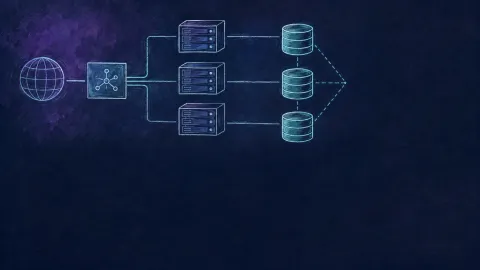
Architecture overview
Follow a request across the stack.
Milestone sequence / 09
Build one layer at a time.
Open the published resources for each milestone and use the planned list as a preview of what is coming next.
- 01
Model the domain using LLD
Define links, aliases, expiry rules, responsibilities and extension points before choosing infrastructure.
entities and value objectsinvariantsservice boundariesPublished resources
- Java OOP for LLDModel responsibility and object state.
- Low Level Design RoadmapUse a repeatable design process.
Planned resources
- URL shortener domain model walkthroughPlanned
- 02
Implement the core logic in Java
Create short codes, resolve destinations and enforce domain rules with testable Java classes.
modern Javacollectionserror handlingPublished resources
- Java Foundations for Backend EngineersReview the Java building blocks used by the service.
- Choosing the Right Java CollectionChoose maps and sets from access patterns.
Planned resources
- Core service implementation and unit testsPlanned
- 03
Expose REST APIs using Spring Boot
Create endpoints for shortening and redirecting while keeping transport concerns outside the domain model.
request lifecyclecontrollers and servicesHTTP contractsPublished resources
- How a Spring Boot Request Flows Through an ApplicationFollow a request through the application boundary.
Planned resources
- URL API contract and controller implementationPlanned
- 04
Add validation, persistence and tests
Store link mappings safely, validate requests and protect behavior with focused tests.
validationrepository boundariesintegration testingPublished resources
No complete resource is linked yet.
Planned resources
- Persistence modelPlanned
- Validation and testing strategyPlanned
- 05
Add caching and rate limiting
Reduce redirect latency and protect write endpoints without hiding freshness or failure behavior.
cache-asideevictionrate limitingPublished resources
- Interactive LRU cache simulatorExplore hits, misses, recency and eviction.
Planned resources
- Cache integrationPlanned
- Token bucket rate limiterPlanned
- 06
Reason about distributed scaling
Estimate demand and decide how identifiers, storage, caches and redirects behave across many instances.
capacity estimationkey generationreplication and failurePublished resources
- Interactive URL Shortener System Design LabBuild the architecture progressively and test its failure behaviour.
- URL Shortener System DesignConnect requirements to the distributed architecture.
- Back of the Envelope EstimationUse workload numbers to guide the design.
Planned resources
- Failure-mode review and scaling worksheetPlanned
- 07
Package the application with Docker
Build a small, reproducible container image with a clear runtime boundary.
image layersmulti-stage buildsnon-root runtimePublished resources
- Docker and Container FundamentalsUnderstand the process and image model.
- A Production Minded Dockerfile for JavaPackage Java with production constraints in view.
Planned resources
- Project Dockerfile and local Compose environmentPlanned
- 08
Deploy it using Kubernetes
Run replicated instances behind stable networking with explicit resources and rollout behavior.
DeploymentsServicesconfiguration and rolloutsPublished resources
- Kubernetes Workload FundamentalsChoose and configure the workload controller.
Planned resources
- Deployment, Service and configuration manifestsPlanned
- 09
Add health checks, metrics, logging and tracing
Make correctness, latency and failure visible before the service reaches production.
health signalsstructured logsmetrics and tracesPublished resources
No complete resource is linked yet.
Planned resources
- OpenTelemetry instrumentationPlanned
- Service dashboard and alert reviewPlanned