
Problem statement
Return true when an integer array is sorted in nondecreasing order. Equal neighboring values are allowed.
[1, 2, 2, 5] is sorted. [1, 4, 3] is not.
Constraints & requirements
- INPUT
- An integer array
- RETURN
- true for nondecreasing order
- EDGE
- Empty and one-value arrays are sorted
Examples 3 test cases
Example 1 Equal neighbours
- Input
[1, 2, 2, 5]- Output
true
Confirms nondecreasing order allows equality.
Example 2 First inversion
- Input
[3, 2, 4]- Output
false
Finds a descending adjacent pair.
Example 3 One value
- Input
[6]- Output
true
Checks the smallest nonempty input.
Hints Optional
01Look for proof of failure
The first descending adjacent pair is enough to return false.
02Start from the second value
Index 0 has no previous neighbor, so comparisons begin at index 1.
03Allow equal values
The array fails only when values[index] is smaller than values[index - 1].
How to think before coding
A brute-force check compares every earlier/later pair. Ask whether all of those comparisons are necessary: if every adjacent pair is ordered, transitivity orders every wider pair too. Therefore start at index 1, compare it with index 0, and return false at the first strict drop. Reaching the end is the proof for true; equality is not a failure.
Brute force and the improvement
Checking every earlier value against every later value costs O(n²) time and O(1) space. It repeats what adjacent comparisons establish. Sorting a copy and comparing it with the original costs O(n log n) time and O(n) space for the copy. Sorting the original alone cannot tell you whether it was sorted before the change.
Intuition
The entire array is sorted only if every neighboring pair is in the correct order. The first pair where values[i] is smaller than values[i - 1] proves that the answer is false.
Java solution
public static boolean isSorted(int[] values) {
    // Null is not an array. An actual empty array is considered sorted.
    if (values == null) {
        return false;
    }

    for (int index = 1; index < values.length; index++) {
        // A strict drop breaks nondecreasing order; equality is allowed.
        if (values[index] < values[index - 1]) {
            return false; // One violation proves the answer; stop immediately.
        }
    }
    return true; // Every adjacent pair passed.
}
Dry run
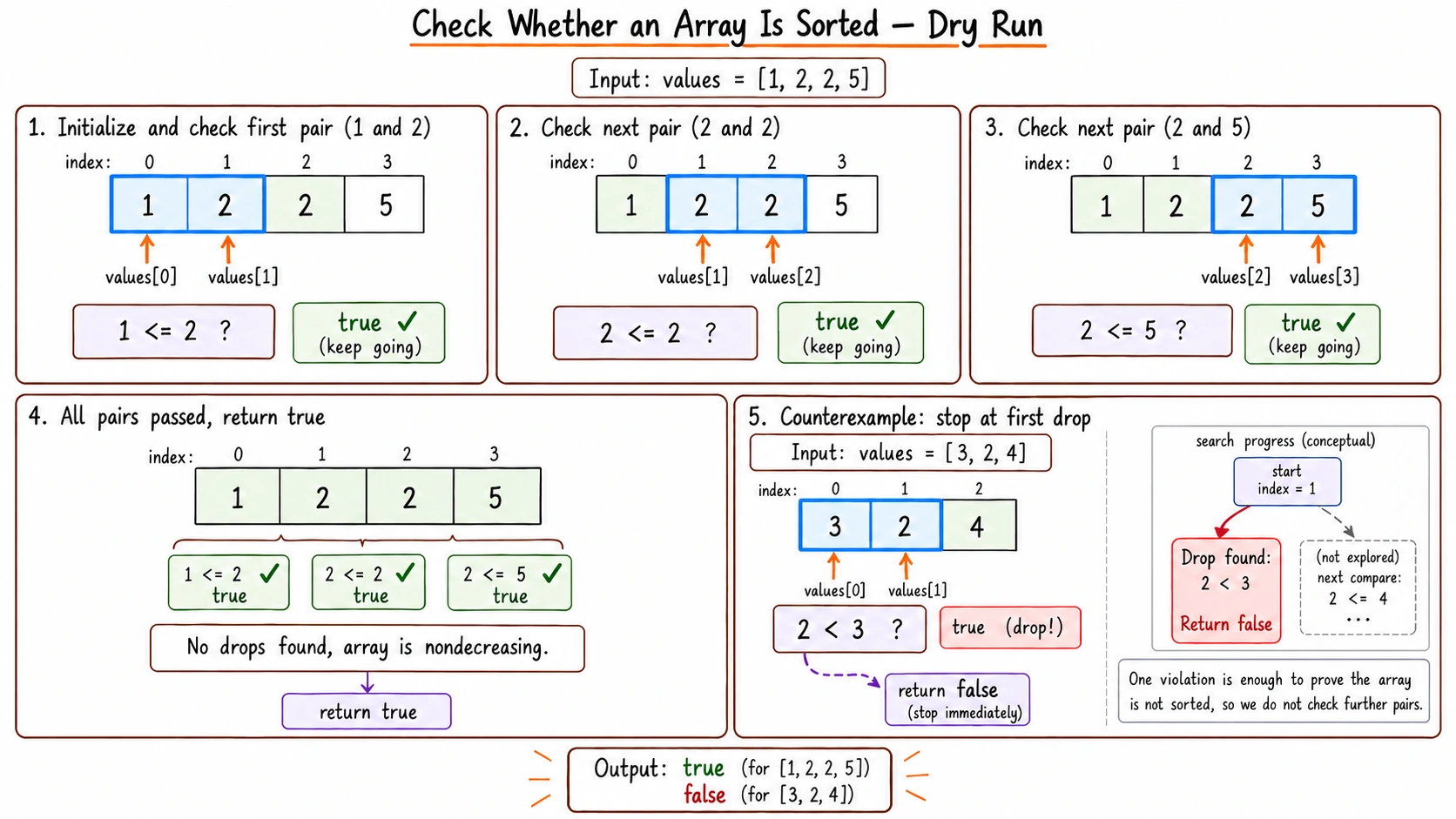
Read the text transcript
For [1, 4, 3], compare adjacent pairs, not every possible pair.
| Index | Previous | Current | Decision |
|---|---|---|---|
| 1 | 1 | 4 | No decrease: continue |
| 2 | 4 | 3 | Decrease: return false immediately |
For [1, 2, 2, 5], all comparisons pass. The equal pair 2, 2 is valid.
Complexity
Time is O(n) in the worst case and extra space is O(1). The method can return early when it finds a violation.
Common mistake
Use < rather than <= when duplicates are valid in nondecreasing order.
Practice next
Next lessonRemove Duplicates from a Sorted ArrayUse sorted order to compact repeated values.