
Problem statement
Given an integer array, return the second largest distinct value. Return null when a second distinct value does not exist.
For [7, 2, 7, 5], the answer is 5.
Constraints & requirements
- INPUT
- An integer array with possible duplicates
- RETURN
- Second largest distinct value, or null
- TARGET
- One pass without sorting
Examples 3 test cases
Example 1 Duplicate maximum
- Input
[7, 2, 7, 5]- Output
5
Checks that the answer must be distinct.
Example 2 Two values
- Input
[2, 9]- Output
2
Checks the smallest successful input.
Example 3 No second value
- Input
[4, 4, 4]- Output
null
Checks the missing-answer contract.
Hints Optional
01Keep only what the answer needs
You do not need the full sorted order. Two running values are enough.
02Handle a new largest carefully
When a value becomes the new largest, the previous largest becomes the second largest.
03Respect distinctness
A value equal to the current largest must not replace the second largest.
How to think before coding
First solve the easier question: what is the maximum? A second scan could then find the greatest value strictly below it. Combine those scans by keeping both candidates. When a new largest arrives, demote the old largest before overwriting it. Otherwise update only the runner-up, and ignore equal maxima. Use null for a missing candidate because every int value may be legitimate.
Brute force and the improvement
Sort, then walk backward past copies of the maximum: O(n log n) time. Copying first preserves the input but needs O(n) extra space. Or make two scans: find the maximum, then the greatest value strictly below it. That also takes O(n) time and O(1) extra space, with two passes rather than one.
Intuition
Sorting works, but it costs O(n log n). We only need the two best distinct values, so keep them while scanning.
When a new largest value appears, the old largest becomes second largest. Otherwise, the current value may fit between them.
Java solution
public static Integer secondLargest(int[] values) {
    // Fewer than two values cannot provide two distinct candidates.
    if (values == null || values.length < 2) {
        return null;
    }

    // Null means missing; a numeric sentinel could be valid input.
    Integer largest = null;
    Integer second = null;

    for (int value : values) {
        // A new maximum pushes the old maximum down into second place.
        if (largest == null || value > largest) {
            second = largest;
            largest = value;
        // Ignore duplicate maxima; only a distinct better runner-up qualifies.
        } else if (value < largest && (second == null || value > second)) {
            second = value;
        }
    }
    return second; // Null means no second distinct value was found.
}
Dry run
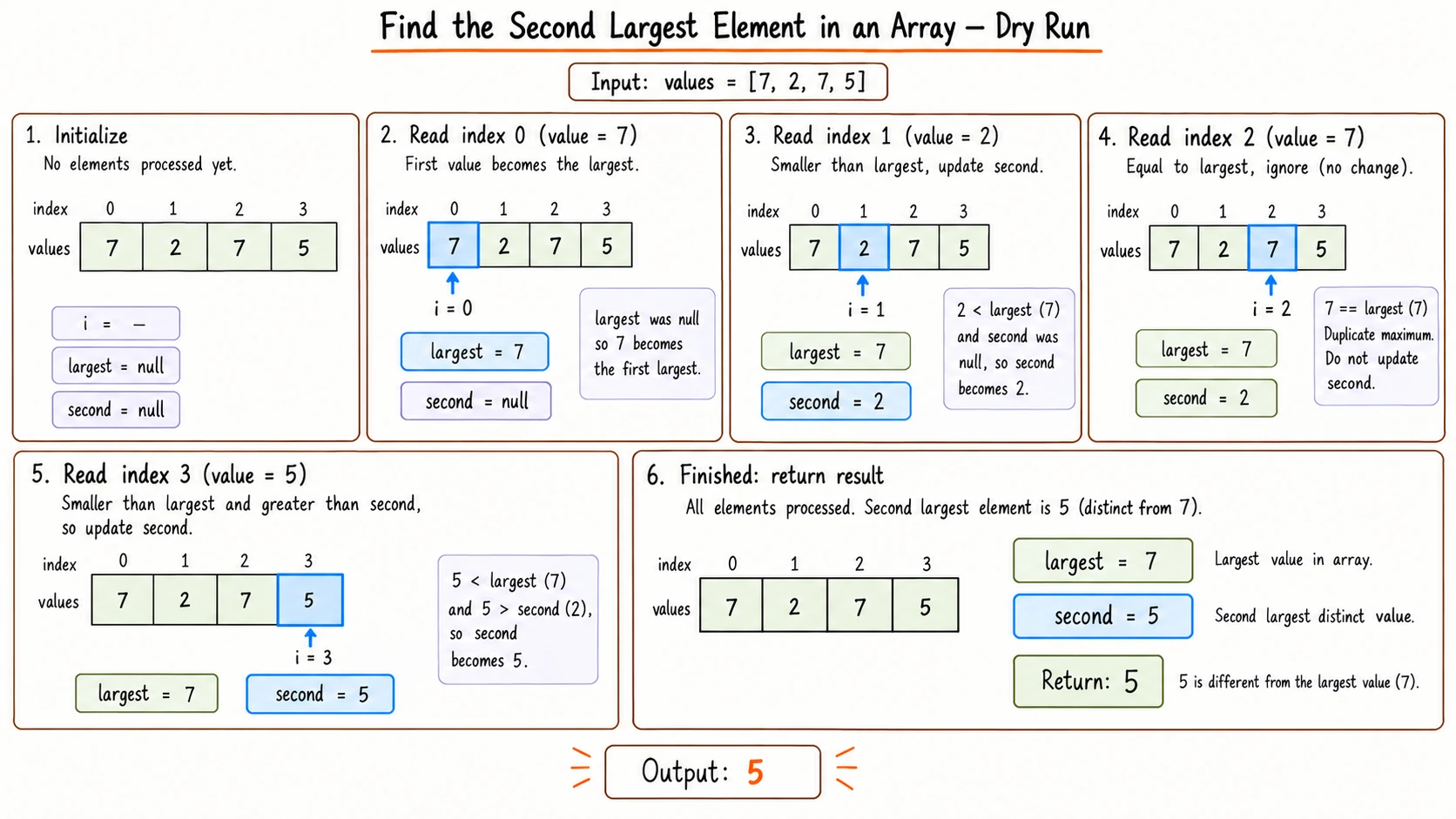
Read the text transcript
For [7, 2, 7, 5], both candidates start as null.
| Read | Decision | Largest | Second distinct |
|---|---|---|---|
| 7 | First candidate becomes largest | 7 | null |
| 2 | Smaller than 7: first runner-up | 7 | 2 |
| 7 | Duplicate maximum: ignore | 7 | 2 |
| 5 | Between 2 and 7: improve runner-up | 7 | 5 |
Return 5. Two occurrences of 7 do not make it the second distinct value.
Complexity
Time is O(n). Extra space is O(1).
Common mistakes
- Treating a duplicate of the largest value as the second largest distinct value
- Using a fixed sentinel such as
Integer.MIN_VALUEwithout thinking about valid input values - Sorting even though the original order may need to stay unchanged
Practice next
Next lessonCheck Whether an Array Is SortedPractice another one-pass invariant.