
Problem statement
Rotate an array of length n to the left by k positions.
For [1, 2, 3, 4, 5] and k = 2, the result is [3, 4, 5, 1, 2].
Constraints & requirements
- INPUT
- An array and rotation count k
- CHANGE
- Rotate the same array
- EDGE
- Normalize k when it exceeds n
Examples 3 test cases
Example 1 Normal rotation
- Input
[1, 2, 3, 4, 5], k = 2- Output
[3, 4, 5, 1, 2]
Checks all three reversals.
Example 2 Large k
- Input
[1, 2, 3], k = 5- Output
[3, 1, 2]
Requires normalizing k by the length.
Example 3 Full rotation
- Input
[4, 8], k = 2- Output
[4, 8]
Checks the no-change case.
Hints Optional
01Name the two blocks
For k = 2, think of the input as A = [1, 2] and B = [3, 4, 5]. The result is BA.
02Reverse both blocks
Reverse A, then reverse B. Their internal order is temporarily reversed.
03Reverse the whole array
One final full reversal restores each block’s order while swapping their positions.
How to think before coding
Write the desired result as two blocks: AB must become BA. A temporary output array makes the mapping obvious; repeated shifts also work but repeat movement. To avoid that storage, notice that reversing each block and then the whole array exchanges their positions while restoring internal order. Normalize k before choosing the three inclusive reversal ranges.
Brute force and the improvement
Using a temporary array is easier to derive and also takes O(n) time, but it needs O(n) extra space. Start with that solution if it helps you understand the index mapping, then learn the reversal method.
With normalized k, place original index i at (i - k + n) % n in a new array, then copy back. Repeated one-position shifts take O(nk) time and O(1) space. A cycle/juggling method also reaches O(n) time and O(1) space but requires careful cycle boundaries.
Intuition
Split the array into two parts: A = [1, 2] and B = [3, 4, 5]. The answer is BA.
We can build BA in place by reversing A, reversing B, and then reversing the entire array.
Java solution
public static void rotateLeft(int[] values, int k) {
    // Stop before modulo n: an empty array would cause division by zero.
    if (values == null || values.length == 0) {
        return;
    }

    int n = values.length;
    k = ((k % n) + n) % n; // Remove full turns; negative k rotates right.

    // Reverse each block, then the whole array: AB becomes BA.
    reverse(values, 0, k - 1);
    reverse(values, k, n - 1);
    reverse(values, 0, n - 1);
}

private static void reverse(int[] values, int left, int right) {
    // Stop when pointers meet or cross; each swap fixes two outer positions.
    while (left < right) {
        int temporary = values[left]; // Preserve the value before overwriting it.
        values[left] = values[right];
        values[right] = temporary;
        left++; // Move both pointers toward the center.
        right--;
    }
}
Dry run
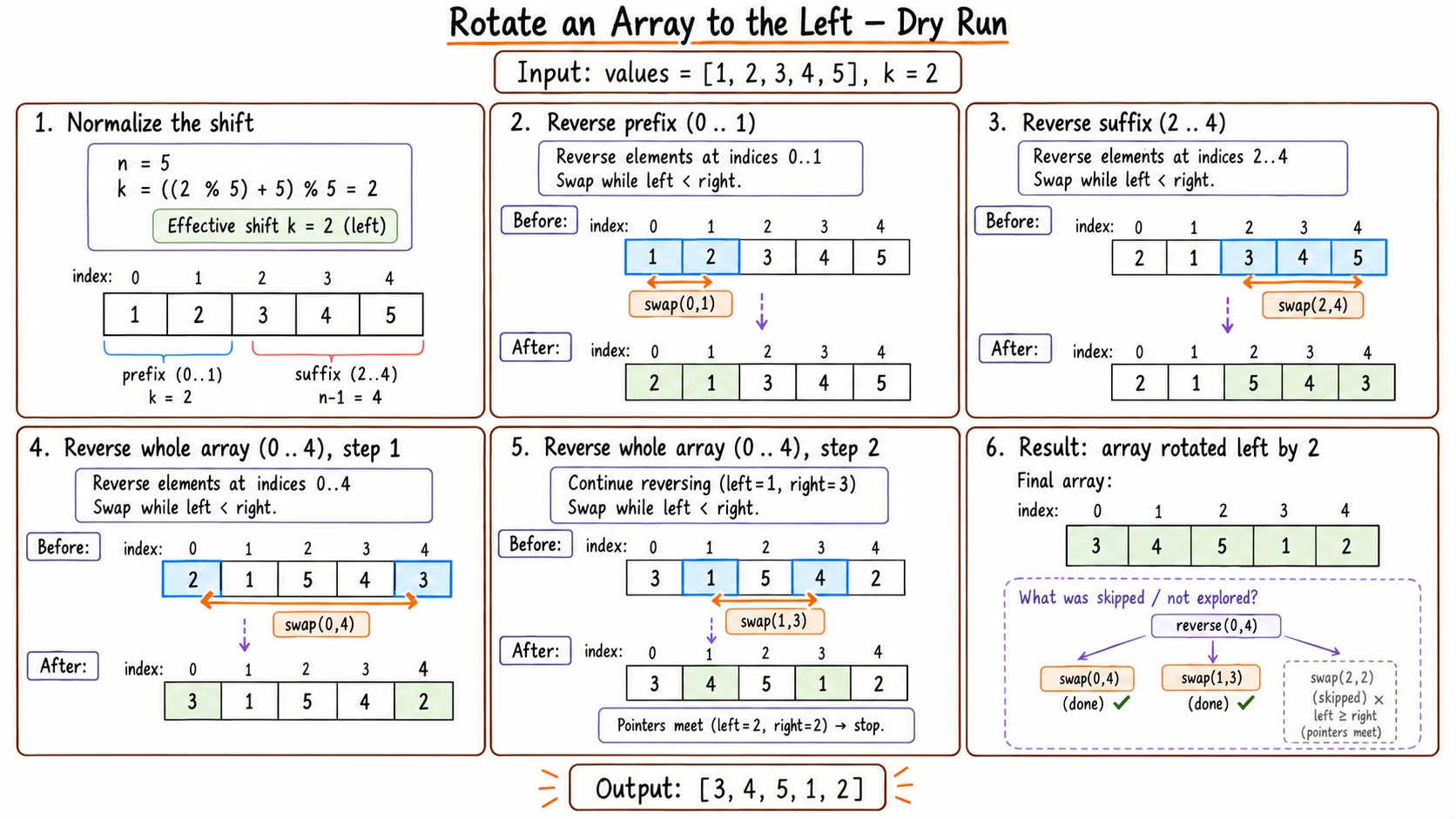
Read the text transcript
For [1, 2, 3, 4, 5], k = 2, the blocks are A = [1, 2], B = [3, 4, 5].
| Operation | Array afterward | Why |
|---|---|---|
| Normalize k | [1, 2, 3, 4, 5] | 2 % 5 is still 2 |
| Reverse indexes 0..1 | [2, 1, 3, 4, 5] | Reverse A |
| Reverse indexes 2..4 | [2, 1, 5, 4, 3] | Reverse B |
| Reverse indexes 0..4 | [3, 4, 5, 1, 2] | Swap blocks and restore each block’s order |
Within reverse, save the left value before overwriting it. For the final reversal, swaps (0,4) and (1,3) transform [2,1,5,4,3] into [3,4,5,1,2]; the pointers then meet at index 2.
Complexity
Time is O(n) and extra space is O(1).
Common mistakes
- Forgetting to reduce
kwith modulon - Dividing by zero when the array is empty
- Mixing the steps for left rotation with the steps for right rotation
Practice next
Next lessonMove Zeroes to the EndCompare another constant-space transformation.